Welcome back to Cinema Obscura, where we dig up the weird, forgotten, and wonderfully strange corners of film history that most people never knew existed.
Key Takeaways
- The Forbidden Zone is a 1980 American absurdist musical fantasy directed by Richard Elfman, born from his avant-garde theater troupe The Mystic Knights of the Oingo Boingo.
- Danny Elfman — years before scoring Batman, Edward Scissorhands, or The Nightmare Before Christmas — composed the soundtrack and stars as Satan in his film debut.
- Hervé Villechaize (Fantasy Island) plays the diminutive King Fausto of the Sixth Dimension, opposite Susan Tyrrell as his tyrannical queen.
- The production bankrupted Richard Elfman, who lost his house financing the film. It was banned by some college campuses and drew an arson threat at an early LA screening.
- After two decades out of circulation, bootleg copies turned it into one of the most sought-after cult films in America.

I should have known that! - A Trivia Game About Things You Oughta Know, Green
Package Quantity :1
As an affiliate, we earn on qualifying purchases.
Before There Was Oingo Boingo
To understand The Forbidden Zone, you have to understand what came before it — and what came before it was one of the strangest performance troupes in American entertainment history.
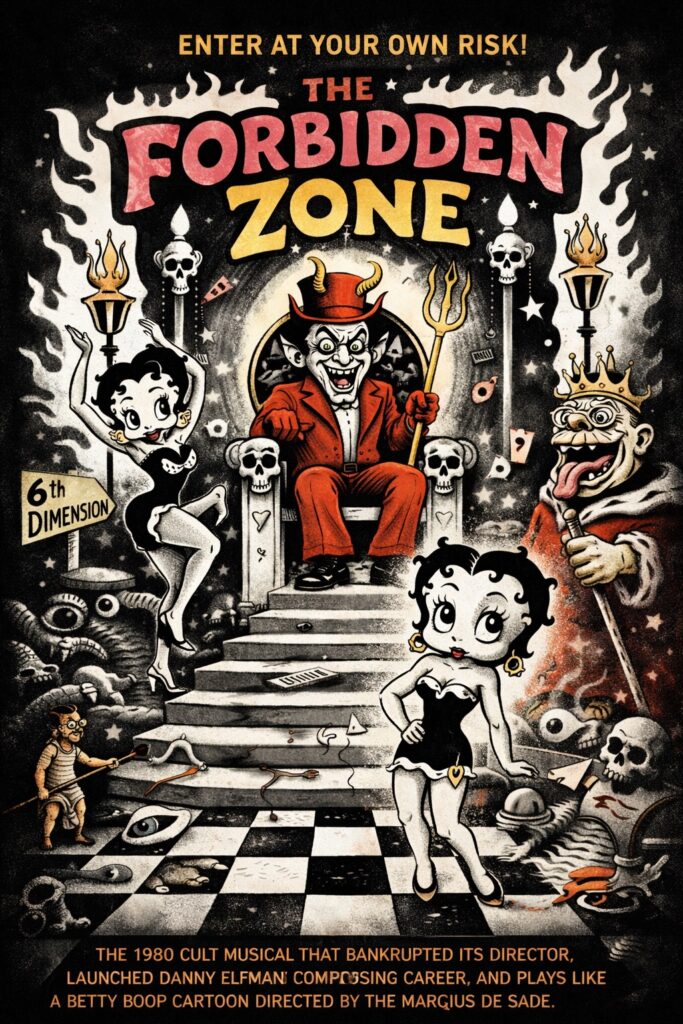
In late 1972, Richard Elfman founded The Mystic Knights of the Oingo Boingo in Los Angeles. This was not a rock band. It was a commedia dell’arte-inspired musical theater troupe — a sprawling ensemble of actors, musicians, and assorted eccentrics who performed elaborately staged cabaret shows blending French absurdist theater, Fleischer Brothers cartoon aesthetics, Harlem Renaissance jazz standards, and German Expressionism. Richard had been inspired by his time in France with the musical comedy troupe Le Grand Magic Circus, whose director Jérôme Savary would go on to lead the French National Theatre.
Richard brought his younger brother Danny into the fold. Danny Elfman, by Richard’s account, had shown zero interest in music as a young man — no guitar, no garage bands, no record collection, no concert-going. But within the Mystic Knights, he found his voice. The troupe was a “semi full of stuff” as Danny later described it, a massive theatrical production that traveled with its own sets, costumes, and elaborate staging.
As the 1970s wound down, the Mystic Knights were at a crossroads. Danny was growing restless with the theatrical format, drawn instead toward the emerging new wave and ska scenes. He wanted to be in a band that could fit its gear in a van and set up in a club. The troupe was evolving away from its cabaret origins toward something leaner and louder — what would eventually become the rock band Oingo Boingo.
Richard saw the writing on the wall. Before the theater troupe dissolved entirely, he wanted to preserve what they’d built on film.

Herd Mentality: Udderly Funny Family Board Game | Easy & Fun for Big Groups of 4-20 Players | Includes 20 Extra Exclusive Questions
Udderly hilarious board game for family and friends game nights. Fun for big groups of 4-20 players
As an affiliate, we earn on qualifying purchases.
A Film Born From Stage Chaos
The project began modestly enough: a 16mm musical called The Hercules Family, consisting of twelve musical numbers loosely strung together with a threadbare plot. But as the concept evolved and the format expanded to 35mm, Richard found himself re-shooting original sequences to fit an increasingly ambitious vision. The result was The Forbidden Zone — though “result” implies a linearity that the production emphatically did not possess.
The plot, insofar as one exists, follows the Hercules family, who discover that a door in their basement leads to the Sixth Dimension. When young Frenchy (Marie-Pascale Elfman, Richard’s then-wife and the film’s production designer) tumbles through, she’s imprisoned by the lustful King Fausto (Hervé Villechaize) and his wrathful Queen Doris (Susan Tyrrell). Her brother and grandfather mount a rescue mission through a landscape populated by frog butlers in tuxedos, topless princesses, jockstrap-wearing goons, a character known as Chicken Boy, and — presiding over Hell itself — Danny Elfman as Satan, performing a gonzo rendition of Cab Calloway’s “Minnie the Moocher” while conducting an orchestra of goblins.
If that paragraph felt exhausting to read, imagine experiencing it at 24 frames per second with no preparation.

The Chameleon: Award-Winning Bluffing Board Game for Family, Adults & Friends | Includes 80 Extra Secret Words | Who is The Imposter?
CATCH THE CHAMELEON: A bluffing board game where players must race to catch the chameleon before It's too...
As an affiliate, we earn on qualifying purchases.
Danny Elfman’s Origin Story
The film’s greatest historical significance may be as the unlikely launching pad for one of Hollywood’s most successful composers. Danny Elfman’s score for The Forbidden Zone was his first film composition — sixty minutes of original music in a dozen different styles, created alongside vintage jazz standards and Oingo Boingo originals.
His single on-screen appearance as Satan is genuinely electrifying. White tuxedo, red face paint, writhing and shimmying through a musical number that channels Cab Calloway’s manic energy through something considerably more demonic. The sequence was originally shot on 16mm for the earlier incarnation of the project, then re-shot on 35mm with alternate lyrics and additional visual elements.
Tim Burton has cited The Forbidden Zone as an influence on The Nightmare Before Christmas — which, given that Danny Elfman wrote the songs and provided Jack Skellington’s singing voice, creates a direct creative lineage from a bankrupt underground musical to one of the most beloved animated films ever made. The film’s theme song was eventually rearranged by Danny as “The Dilbert Zone” for the television series Dilbert, which might be the most unexpected career trajectory in the history of film composition.

Hunch Games Put A Finger Down - Hilarious Party Card Game for Adults, Game Night, Parties, Big and Small Groups | Fun Social Icebreaker with 400 Cards for 2+ Players
VIRAL TREND AT THE TABLE – Bring the familiar challenge to game night with prompts, reactions, and relatable...
As an affiliate, we earn on qualifying purchases.
The Cast of Misfits
The casting reads like a roll call of cult cinema’s most fascinating figures. Hervé Villechaize, best known as Tattoo on Fantasy Island and Nick Nack in The Man with the Golden Gun, was a former roommate of co-writer and co-star Matthew Bright. He would come to the set on weekends to help paint scenery. Susan Tyrrell, an Oscar-nominated actress for Fat City (1972) who went on to appear in John Waters’ Cry-Baby and Paul Verhoeven’s Flesh+Blood, brought a ferocious, unhinged energy to Queen Doris. Joe Spinell, the character actor from Rocky, The Godfather Part II, and the notorious slasher film Maniac (1980), makes an appearance.
Matthew Bright, who co-wrote the screenplay with Richard Elfman, would later direct the darkly brilliant Freeway (1996) starring Reese Witherspoon. Marie-Pascale Elfman, in addition to starring and designing the production, helped finance the film by buying, renovating, and selling houses with Richard.
The remaining roles were filled by Mystic Knights members, crew family, and assorted Los Angeles eccentrics. The collective energy is less “professional film production” and more “extremely talented people having the time of their lives in a warehouse.”
The Color Problem
The Forbidden Zone was shot in black and white, but not entirely by choice. Richard Elfman’s original plan was to ship the completed film to China, where each frame would be hand-tinted — a process that would have given the film the look of a colorized Fleischer Brothers cartoon. The plan proved financially impossible within the production budget, so the film was released in its monochrome form.
Decades later, Elfman finally realized his color vision. A hand-tinted color version was created and released, offering viewers a choice between the stark black-and-white original (which many fans prefer for its resemblance to early animated shorts) and the lurid, candy-colored alternative.
Bankruptcy and Bootlegs
The production’s financial story is grimly predictable. Richard Elfman and his then-wife Marie-Pascale poured their personal finances into the film, buying and selling houses to fund production. When that wasn’t enough, actor and former Mystic Knight Gene Cunningham contributed money, followed by producer Carl Borack, who stepped in to allow Elfman to finish.
It wasn’t enough. Richard Elfman went bankrupt during production and had to assign away the rights to the film in order to complete it. He wouldn’t regain full ownership until 2015 — thirty-five years after the film’s completion.
The commercial reception was equally brutal. The Forbidden Zone premiered at the Los Angeles Filmex festival in 1980, played midnight screenings at the New Beverly Cinema, and received a limited theatrical release through The Samuel Goldwyn Company in 1982. Some college campuses banned it. An early Los Angeles screening drew an arson threat that cleared the theater. It was not, by any commercial measure, a success.
And then it disappeared. For roughly twenty years, The Forbidden Zone was out of circulation entirely — no home video release, no television broadcasts, nothing. But bootleg VHS tapes circulated through the underground, and the film’s reputation grew with every generation of viewers who encountered it through third-generation copies traded at punk shows, comic conventions, and midnight movie circles. By the time it finally received a proper DVD release in 2004, it had become one of the most sought-after cult films in America.
What It Feels Like
Describing the experience of watching The Forbidden Zone is genuinely difficult. The Criterion Collection hasn’t touched it (yet), the BFI hasn’t run a retrospective, and mainstream critics have largely ignored it. The audience for this film has always been self-selecting: people who see the phrase “Danny Elfman plays Satan in an underground musical about a portal to the Sixth Dimension” and feel their pupils dilate rather than their brow furrow.
The closest analogies are all partial. Rocky Horror shares the midnight-movie DNA but is far more polished and conventional in its storytelling. John Waters’ early work shares the transgressive energy but operates in a different register of filth. The Fleischer Brothers’ Betty Boop cartoons provide the aesthetic template, but those were three-minute shorts, not feature-length assaults on good taste.
What The Forbidden Zone actually feels like is being trapped inside the collective imagination of a dozen wildly creative people who have no budget, no supervision, and no interest whatsoever in making anything that a normal human being would consider acceptable entertainment. It’s exhausting, exhilarating, frequently offensive, and completely unlike anything else in American cinema.
Quick Facts
| Detail | Info |
|---|---|
| Title | Forbidden Zone |
| Year | 1980 (premiere) / 1982 (theatrical) |
| Runtime | 76 minutes |
| Director | Richard Elfman |
| Writers | Richard Elfman, Matthew Bright |
| Music | Danny Elfman, The Mystic Knights of the Oingo Boingo |
| Notable Cast | Hervé Villechaize, Susan Tyrrell, Danny Elfman, Marie-Pascale Elfman, Joe Spinell |
| Country | USA |
| Format | Originally black and white; color version later released |
| IMDb Rating | 6.5/10 |
| Home Video | Multiple DVD editions; Director’s Cut available |
Frequently Asked Questions
Is This Danny Elfman’s First Film Work?
Yes. The Forbidden Zone soundtrack was Danny Elfman’s first film score, predating his collaboration with Tim Burton by several years. His on-screen performance as Satan also represents his film acting debut. The score blends original compositions with vintage jazz standards performed by the Mystic Knights.
Who Were The Mystic Knights of the Oingo Boingo?
A musical theater troupe founded by Richard Elfman in 1972 in Los Angeles. The ensemble performed elaborate cabaret shows blending French absurdism, jazz, commedia dell’arte, and Fleischer Brothers-inspired visuals. As the troupe wound down, Danny Elfman transformed it into the new wave rock band Oingo Boingo, known for hits like “Dead Man’s Party” and “Weird Science.”
Why Was the Film Banned on Some College Campuses?
The film contains graphic nudity, racially provocative content (including blackface sequences), and transgressive sexual imagery that generated significant controversy. Context has shifted considerably since 1980, and viewers should be aware that some content would be considered deeply offensive by contemporary standards.
Is There a Color Version?
Yes. The film was originally released in black and white due to budget constraints, but Richard Elfman always intended it to be in color. A hand-tinted color version was eventually created and released alongside the original black-and-white version. Fan opinion is divided on which version is superior.
Did Tim Burton Really Cite This Film as an Influence?
Yes. Burton has acknowledged The Forbidden Zone as an influence on The Nightmare Before Christmas, creating a direct creative lineage between the Elfman brothers’ underground musical and one of the most commercially successful animated films ever made.
Cinema Obscura is a recurring series on Choking on Popcorn where we explore the strangest, most forgotten, and most fascinating films that most people have never heard of. Got a suggestion for a future entry? Contact us.