
Welcome back to Cinema Obscura, where we dig up the weird, forgotten, and wonderfully strange corners of film history that most people never knew existed.
Key Takeaways
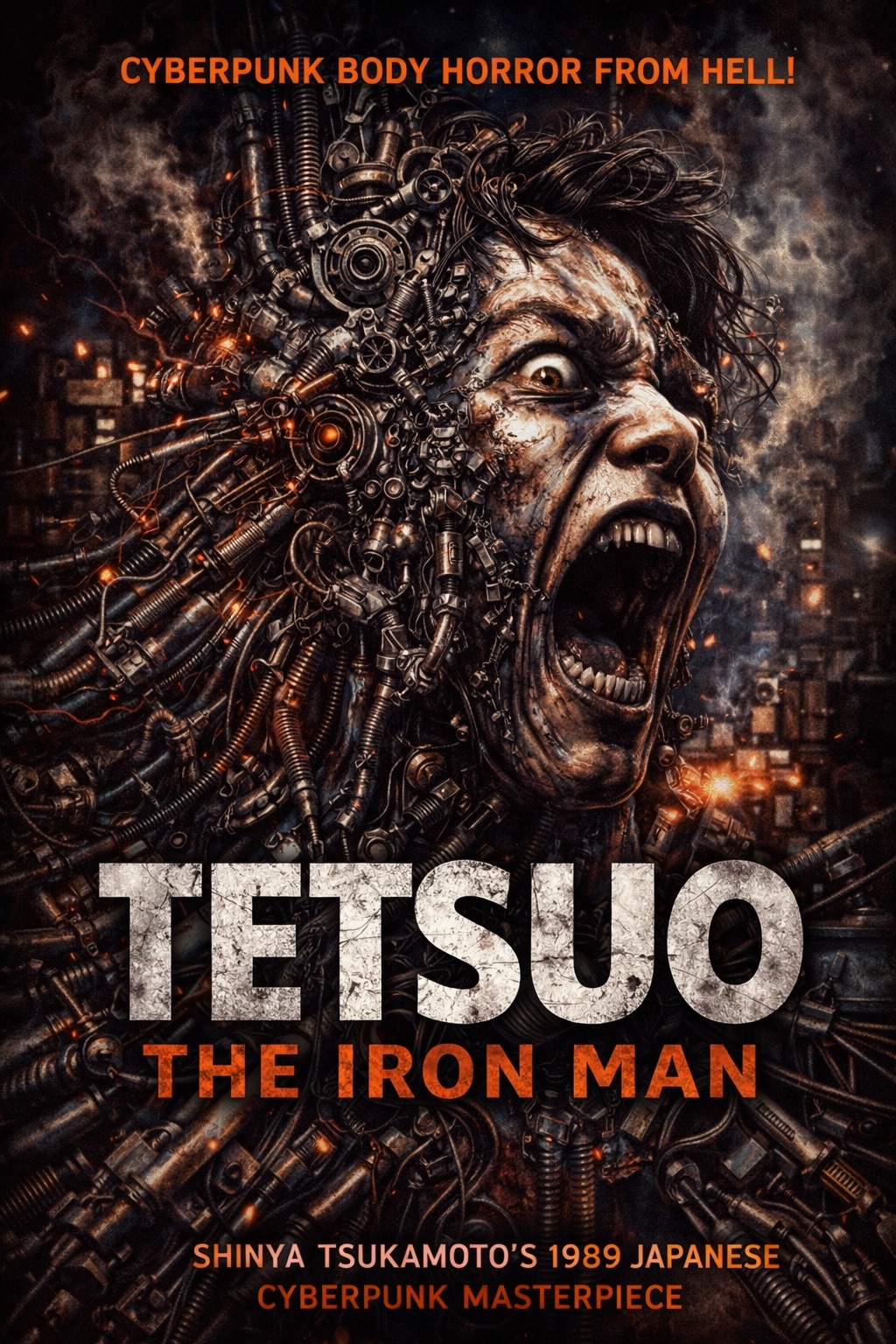
- Tetsuo: The Iron Man is a 1989 Japanese cyberpunk body horror film written, directed, produced, shot, and edited by Shinya Tsukamoto — who also stars as the antagonist.
- A salaryman gradually transforms into a walking heap of scrap metal after a hit-and-run involving a “metal fetishist,” in what amounts to 67 minutes of relentless sensory assault.
- The film was shot on 16mm black-and-white stock over 18 months, primarily in actress Kei Fujiwara’s apartment, where most of the cast and crew lived on set.
- Nearly the entire crew abandoned production before completion — only Tsukamoto and lead actor Tomorowo Taguchi remained to finish the film.
- It premiered at an 80-seat Tokyo theater for late-night screenings and went on to become the defining work of Japanese cyberpunk cinema, selling over 10,000 home video copies in Japan alone.
Top picks for "tetsuo iron"
Open Amazon search results for this keyword.
As an affiliate, we earn on qualifying purchases.
67 Minutes That Rewired a Genre

There are films that push boundaries, and then there’s Tetsuo: The Iron Man — a film that doesn’t so much push boundaries as drill through them with a massive rotating metal appendage (which, incidentally, is something that literally happens in the movie).
Shinya Tsukamoto’s 1989 debut feature arrived at the tail end of a decade defined by body horror and cyberpunk. David Cronenberg had given us Videodrome (1983). David Lynch had seared Eraserhead (1977) into the collective unconscious. William Gibson’s Neuromancer (1984) had established cyberpunk as a literary genre. Katsuhiro Otomo’s Akira (1988) had redefined what animated science fiction could do.
Tetsuo absorbed all of these influences, ran them through a meat grinder, fused the remains with scrap metal, and produced something that makes its predecessors look restrained by comparison. It is 67 minutes long — barely feature length — and it uses every one of those minutes like a jackhammer uses concrete.
The Story (Such As It Is)
A man referred to only as the Metal Fetishist — played by Tsukamoto himself — slices open his thigh and inserts a length of scrap metal into the wound. When maggots begin colonizing the festering gash, he panics, runs screaming into the night, and is struck by a car driven by a typical Tokyo salaryman (Tomorowo Taguchi) and his girlfriend (Kei Fujiwara). The couple investigates, discovers the body, and dumps it.
Shortly after, the salaryman notices a metallic shard protruding from his cheek while shaving. It’s the beginning of a transformation that will consume his entire body — wires, cables, drills, and steel sprouting from his flesh in an agonizing metamorphosis that blurs the line between man and machine. The Metal Fetishist, somehow still alive, haunts his dreams and pursues him through the industrial wastelands of Tokyo.
If that sounds like a conventional narrative, be reassured: it absolutely does not play like one. The film unfolds more like a series of escalating hallucinations than a story, its structure closer to an industrial music album than a three-act screenplay. Dialogue is minimal. Exposition is nonexistent. The soundtrack — composed by Chu Ishikawa — is a relentless barrage of clanging metal and electronic distortion that functions less as music and more as aural violence.
The Production That Nearly Killed Everyone
The making of Tetsuo is legendary for its brutality. Tsukamoto, who served as writer, director, producer, art director, lighting director, cinematographer, and editor, shot the film on 16mm black-and-white stock over approximately 18 months. The primary location was Kei Fujiwara’s apartment, where most of the cast and crew effectively lived during production.
The conditions were, by all accounts, miserable. The claustrophobic quarters, the demanding director, and the physically grueling practical effects work took their toll. As film scholar Tom Mes documents in his book Iron Man: The Cinema of Shinya Tsukamoto, crew members began abandoning the production one by one. The tensions were not creative disagreements — they were the result of exhaustion, proximity, and Tsukamoto’s apparently limitless capacity for demanding more.
Fujiwara herself left before production was complete, despite having served as both co-cinematographer and actress. By the final stretch of filming, only two people remained: Tsukamoto and Tomorowo Taguchi, who had to light his own scenes in addition to performing in them. The fact that the finished film exhibits any coherence at all — let alone the ferocious, unified vision it actually delivers — is a testament to Tsukamoto’s sheer stubbornness.
The Look and Sound of Urban Nightmares
Tsukamoto has spoken about wanting to portray Tokyo as an “urban jungle” — and Tetsuo delivers that vision with hallucinatory intensity. The city in the film is composed entirely of backstreets, industrial workshops, railway yards, and the kind of spaces where bodies could be hidden without anyone noticing. It’s Tokyo stripped of neon and commerce, reduced to its industrial skeleton.
The black-and-white photography is high-contrast and often deliberately disorienting, shot with handheld cameras that move with the frantic energy of someone being chased. The practical effects — metal prosthetics, stop-motion animation, and in-camera compositing — are crude by any commercial standard and absolutely perfect for the film’s purposes. The transformation sequences, in which metal erupts from skin in jerky, frame-by-frame progressions, have a visceral, nightmarish quality that CGI has never been able to replicate.
The BFI noted that despite being “so abrasive to watch and listen to,” the film is paradoxically accessible — light on plot complexities, sparse on dialogue, and short enough to watch in the time it takes to get through a single episode of prestige television.
Cyberpunk Made Flesh
Critics have placed Tetsuo firmly within the cyberpunk tradition, but Tsukamoto himself has complicated that categorization. He acknowledged Blade Runner (1982) and Videodrome (1983) as “two parents of Tetsuo” but noted that Western cyberpunk tended to deal with worlds already transformed by technology, while his film was about the horrifying process of that transformation happening to an ordinary person in real time.
Film scholar Tom Mes expanded on this distinction, noting that Tsukamoto works from a specifically Japanese context — the numbing experience of city life, office work, and hours-long commutes that rob people of their humanity. The salaryman’s metal transformation isn’t just body horror; it’s a literalization of what Tokyo’s grinding economic machinery does to the human beings who feed it.
When asked about the film’s meaning, Tsukamoto responded that it was about “the process in which human beings become ‘Iron’; that is, it’s some kind of human condition.” In a later interview, he described an interest in “the erotic elements of juxtaposing a soft body against hard iron” — a statement that the film’s more graphic sequences illustrate with unsettling thoroughness.
The Premiere and After
When Tetsuo was complete, Tsukamoto chose to premiere it at Nakano Musashino Hall, which he described as “the smallest theatre in Tokyo” — a venue with a capacity of 80 people equipped with a 16mm projector, booked for late-night screenings in July 1989.
From that 80-seat theater, the film conquered the world. It broke box-office records for non-mainstream cinema in Japan, sold over 10,000 home video copies domestically (an extraordinary number for an underground film), and found enthusiastic audiences in the US and UK through festival screenings and specialty distributors. It won the Best Film award at the 1989 Fantastic Film Festival in Rome.
Tsukamoto went on to build a substantial career — directing the color sequel Tetsuo II: Body Hammer (1992), the boxing drama Tokyo Fist (1995), Bullet Ballet (1998), and many others. He’s also an accomplished actor, appearing in films by Takashi Miike (including Ichi the Killer) and even providing the Japanese voice of Vamp in Metal Gear Solid 4.
But Tetsuo: The Iron Man remains his calling card — a 67-minute eruption of creative fury that defined Japanese cyberpunk and proved that a film made in an apartment by a skeleton crew with no money could hit harder than anything a major studio had ever produced.
Quick Facts
| Detail | Info |
|---|---|
| Title | Tetsuo: The Iron Man (鉄男) |
| Year | 1989 |
| Runtime | 67 minutes |
| Director | Shinya Tsukamoto |
| Writer | Shinya Tsukamoto |
| Lead Cast | Tomorowo Taguchi, Kei Fujiwara, Shinya Tsukamoto |
| Music | Chu Ishikawa |
| Format | 16mm, black and white |
| Country | Japan |
| Production | Kaijyu Theatre |
| IMDb Rating | 6.9/10 |
| Sequels | Tetsuo II: Body Hammer (1992), Tetsuo: The Bullet Man (2009) |
| Home Video | Arrow Video (Solid Metal Nightmares box set, Blu-ray, 2020) |
Frequently Asked Questions
Is Tetsuo: The Iron Man Related to the Marvel Character?
No. The title refers to the Japanese word “tetsuo” (鉄男), which literally means “iron man.” The film predates the MCU by nearly two decades and shares nothing with the Marvel franchise beyond the English subtitle — though the BFI has noted that parents should be very careful not to confuse the two.
How Graphic Is the Film?
Extremely. The film contains graphic body horror, sexual violence, and disturbing imagery throughout its runtime. It is emphatically not for squeamish viewers.
What Influenced the Film?
Tsukamoto has cited David Lynch’s Eraserhead, David Cronenberg’s Videodrome, and Ridley Scott’s Blade Runner as direct influences. The film also shares DNA with Akira and the broader Japanese cyberpunk and underground theater movements of the 1980s.
Where Can I Watch It?
Arrow Video’s Solid Metal Nightmares Blu-ray box set (2020) collects several Tsukamoto films including Tetsuo. It’s also available through various digital rental platforms and specialty distributors.
Is the Sequel Worth Watching?
Tetsuo II: Body Hammer (1992) revisits similar themes with a larger budget and color photography. It’s generally considered a companion piece rather than a direct sequel, and opinions on it are divided — some prefer its expanded scope, others feel it lacks the raw intensity of the original.
Cinema Obscura is a recurring series on Choking on Popcorn where we explore the strangest, most forgotten, and most fascinating films that most people have never heard of. Got a suggestion for a future entry? Contact us.