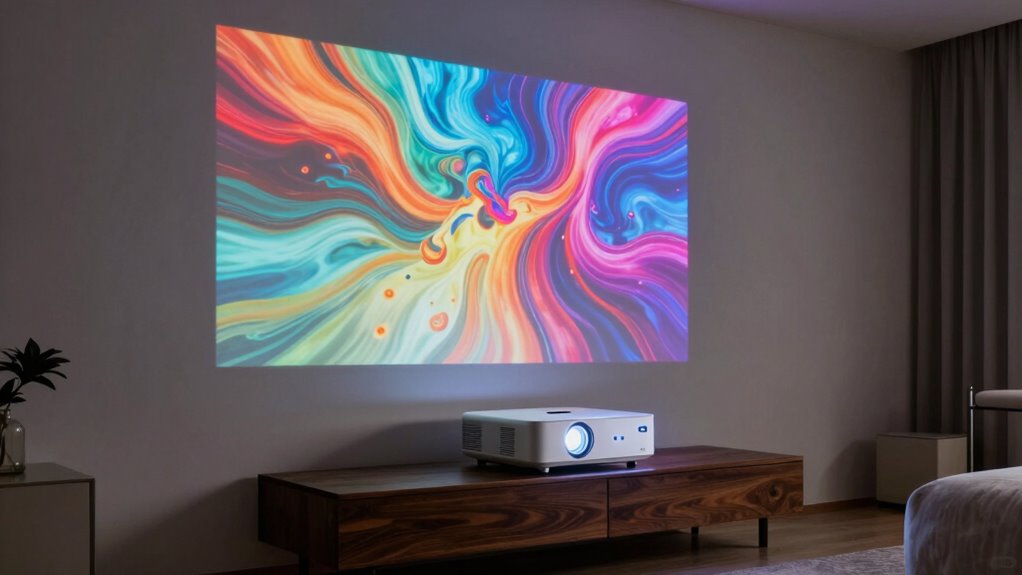

Choosing a projector for a 120-inch screen is about more than whether a model can technically create a large image. Brightness, room lighting, throw distance, installation flexibility, and how you watch all affect whether that screen feels satisfying. I would start with the ViewSonic LS740HD for a bright, fixed installation, the PX700HDH for a lower-complexity Full HD setup with stronger gaming credentials, or the HAPPRUN if built-in streaming and portability matter more than light output.

Get movie nights delivered free with Prime
- Fast, free delivery on millions of items
- Prime Video, Amazon Music and more included
- Member-only deals all year
These three models serve different rooms. The LS740HD has the most brightness and installation adjustments, but its stationary design makes it a poor match for casual moving between rooms. The PX700HDH offers a brighter-than-portable picture and 120 Hz support, though it lacks listed wireless streaming. The HAPPRUN is the easiest to move and use with apps, but its 1,500 ANSI lumens make a 120-inch image more dependent on a dim room. I rank them by how well their strengths translate into practical large-screen viewing, not simply by maximum advertised image size.
Key Takeaways
- The ViewSonic LS740HD is my pick for a fixed 120-inch screen in a room with ambient light, thanks to its 5,500 ANSI lumens and installation adjustments.
- The ViewSonic PX700HDH balances Full HD, 3,700 ANSI lumens, and 120 Hz support, but streaming requires an external device.
- The HAPPRUN is the most portable and app-friendly option, yet its lower brightness makes a darkened room the safer choice at 120 inches.
- All three list image sizes above 120 inches, but a stated maximum does not guarantee the same brightness or clarity at every size.
- Check throw distance and mounting position before choosing: the LS740HD has the widest listed installation toolkit, while the HAPPRUN is easiest to relocate.
| ViewSonic LS740HD 1080p Laser Projector |  | Best Overall for a Fixed 120-Inch Screen | Resolution: 1920 × 1080 (Full HD) | Brightness: 5,500 ANSI lumens | Screen size: 30–300 inches | VIEW ON AMAZON | See Our Full Breakdown |
| ViewSonic PX700HDH Full HD 1080p DLP Projector |  | Best for Gaming and Brighter Home Viewing | Resolution: 1920 × 1080 | Display technology: DLP | Brightness: 3,700 ANSI lumens | VIEW ON AMAZON | See Our Full Breakdown |
| HAPPRUN 1080p Smart Projector with 1500 ANSI Lumens |  | Best Portable Option with Built-In Streaming | Native resolution: 1920 × 1080 | Maximum decoded resolution: 3840 × 2160 pixels | Brightness: 1,500 ANSI lumens | VIEW ON AMAZON | See Our Full Breakdown |
| projectors for large screens 120 inch | Brightness | Connectivity | Resolution | Throw ratio |
|---|---|---|---|---|
| ViewSonic LS740HD 1080p Laser | 5,500 ANSI lumens | 2 HDMI 1.4, USB Type-A, RS232, 3.5 mm audio out | 1920 × 1080 (Full HD) | 1.13–1.47 |
| ViewSonic PX700HDH Full HD 108 | 3,700 ANSI lumens | Dual HDMI, USB, Mini USB, 3.5 mm audio | 1920 × 1080 | 1.5–1.6 |
| HAPPRUN 1080p Smart Projector | 1,500 ANSI lumens | Wi-Fi 6, Bluetooth 5.2, HDMI, USB, 3.5 mm jack | — | — |
More Details on Our Top Picks
ViewSonic LS740HD 1080p Laser Projector
The ViewSonic LS740HD is my leading choice when a 120-inch screen will have a dedicated place. Its 5,500 ANSI lumens give it the greatest stated brightness in this group, a meaningful advantage when a large image has to remain visible in a classroom, boardroom, or multipurpose room that cannot be fully darkened. It still uses Full HD resolution, like the other two, so its advantage is light output and installation flexibility rather than extra pixel detail.
Its 1.3× optical zoom, 1.13–1.47 throw ratio, horizontal and vertical keystone, four-corner adjustment, and 360-degree projection give installers more ways to fit the image to a room. Compared with the PX700HDH, that makes positioning less constrained; compared with the HAPPRUN, it is built for a deliberate mounted setup rather than an easy carry-and-play routine. The laser light source is listed for up to 30,000 hours in Dynamic Eco mode, which also makes it a stronger match for frequent use than a projector whose listed lamp life is shorter.
The tradeoff is commitment. This is a stationary installation model, and no wireless connectivity is listed, so plan on wired sources and a suitable mounting location. Its brightness cannot fix a poor screen, an unsuitable throw distance, or a room with uncontrolled light, and buyers who want a small projector to shift between rooms should choose the HAPPRUN instead. I would pick the LS740HD for a high-use 120-inch installation where brightness and placement options outweigh portability.
Pros:- Highest stated brightness here at 5,500 ANSI lumens
- Laser light source rated up to 30,000 hours in Dynamic Eco mode
- Zoom, H/V keystone, four-corner adjustment, and 360-degree projection support flexible installation
- Full HD image with dual HDMI inputs and a built-in 15W speaker
Cons:- Stationary design is a poor fit for frequent relocation
- No wireless connectivity is listed
- Full HD resolution does not provide the added detail of native 4K
Best for: Buyers mounting a 120-inch Full HD screen in a classroom, boardroom, simulator space, or multipurpose room with some ambient light.
Not ideal for: People who need a portable projector, built-in wireless streaming, or a simple occasional-use setup without ceiling mounting.
- Resolution:1920 × 1080 (Full HD)
- Brightness:5,500 ANSI lumens
- Screen size:30–300 inches
- Throw ratio:1.13–1.47
- Optical zoom:1.3×
- Light source:Laser phosphor; up to 30,000 hours in Dynamic Eco mode
- Installation adjustments:H/V keystone, four-corner adjustment, portrait mode, 360-degree projection
- Connectivity:2 HDMI 1.4, USB Type-A, RS232, 3.5 mm audio out
Our verdict“I recommend the LS740HD for a permanent 120-inch screen when brightness and installation flexibility matter more than portability.”
ViewSonic PX700HDH Full HD 1080p DLP Projector
The ViewSonic PX700HDH is the better fit for buyers who want a versatile Full HD projector without committing to the LS740HD’s installation-focused design. At 3,700 ANSI lumens, it has more stated brightness than the HAPPRUN and offers a more plausible route to a 120-inch image in a room with some ambient light. For a dedicated dark home theater, its 1080p resolution can make sense; for rooms that stay bright, the LS740HD has a substantial brightness advantage.
Its 120 Hz refresh rate and 16 ms input latency make this the clearest gaming pick in the lineup. Those specifications matter more to responsive play than the HAPPRUN’s built-in streaming apps, while dual HDMI inputs make it easier to leave more than one source connected. The 1.1× optical zoom and vertical keystone correction help with basic placement, but they offer less installation latitude than the LS740HD’s wider adjustment suite.
There is a specification caveat: the provided details list a 6,000-hour light-source life, while the description also claims up to 20,000 hours. I would verify the current manufacturer documentation before basing a long-term ownership decision on the higher figure. Wireless connectivity is not listed, so streaming requires a connected player or console. I would choose this model over the HAPPRUN for a brighter, gaming-oriented setup, but skip it if app access without extra hardware or extensive mounting adjustments is the priority.
Pros:- 3,700 ANSI lumens provide more stated brightness than the HAPPRUN
- Full HD DLP resolution with SuperColor and a listed 22,000:1 contrast ratio
- 120 Hz refresh rate and 16 ms input latency suit fast-paced gaming
- Dual HDMI, optical zoom, and vertical keystone support a practical home setup
Cons:- No built-in wireless connectivity is listed
- Supplied light-source-life information conflicts between 6,000 and up to 20,000 hours
- Vertical keystone and 1.1× zoom provide less placement flexibility than the LS740HD
Best for: Home users who want a bright Full HD 120-inch image for gaming, sports, and mixed entertainment, with sources connected by HDMI.
Not ideal for: Buyers seeking built-in streaming apps, wireless connectivity, extensive installation correction, or a clearly consistent lamp-life specification.
- Resolution:1920 × 1080
- Display technology:DLP
- Brightness:3,700 ANSI lumens
- Contrast ratio:22,000:1
- Refresh rate and input latency:120 Hz; 16 ms
- Throw ratio:1.5–1.6
- Optical zoom and correction:1.1× optical zoom; vertical keystone
- Connectivity:Dual HDMI, USB, Mini USB, 3.5 mm audio
Our verdict“I would choose the PX700HDH for a bright, gaming-friendly 120-inch Full HD setup, provided an external streaming source is acceptable.”
HAPPRUN 1080p Smart Projector with 1500 ANSI Lumens
The HAPPRUN 1080p Smart Projector is the easiest of these three to carry and use without assembling a separate streaming setup. It weighs 2.5 pounds, lists access to Netflix, Prime Video, and YouTube, and includes Wi-Fi 6, Bluetooth 5.2, automatic focus, and built-in Dolby Audio speakers. If I wanted a projector for movie nights in different rooms, those conveniences would matter more than the LS740HD’s mounting adjustments or the PX700HDH’s gaming latency.
For a 120-inch screen, however, the main compromise is its 1,500 ANSI lumens. It can support a large image according to its listed 40–300-inch range, but a 120-inch picture is more likely to suit a dimmed room than a space with daylight or strong room lighting. The PX700HDH offers considerably more stated brightness, and the LS740HD leads by a wider margin. The HAPPRUN’s native resolution is 1080p; its 4K decoding should not be mistaken for a native 4K panel, so it does not gain the fine detail of a true 4K projector.
Automatic focus and multiple mounting options make setup approachable, while HDMI, USB, and a 3.5 mm jack preserve options for external sources and audio. The listed 1.5–18-foot throw distance is broad, but buyers still need to check whether their room can place the projector correctly for a 120-inch image. I would select it when portability and built-in apps are the main requirements; I would skip it for a bright room or a permanent large-screen installation where the ViewSonic models have stronger practical advantages.
Pros:- Portable 2.5-pound design with several mounting options
- Built-in access to popular streaming apps and Wi-Fi 6
- Native 1080p resolution with automatic focus
- Bluetooth 5.2 and built-in Dolby Audio speakers
Cons:- Lowest stated brightness in this comparison at 1,500 ANSI lumens
- 4K decoding does not change the native 1080p resolution
- A 120-inch image needs adequate throw distance and a suitably dim room
Best for: Viewers who want to carry a projector between rooms and stream from built-in apps on a 120-inch screen in a darkened space.
Not ideal for: Buyers who need a bright 120-inch image with room lights on, native 4K resolution, or a high-use fixed installation.
- Native resolution:1920 × 1080
- Maximum decoded resolution:3840 × 2160 pixels
- Brightness:1,500 ANSI lumens
- Contrast ratio:20,000:1
- Supported image size:40–300 inches
- Throw distance:1.5–18 feet
- Connectivity:Wi-Fi 6, Bluetooth 5.2, HDMI, USB, 3.5 mm jack
- Weight and audio:2.5 pounds; built-in Dolby Audio speakers
Our verdict“I recommend the HAPPRUN when portability and app access outweigh the lower brightness available for a 120-inch image.”

How We Picked
I compared these projectors around one specific job: producing a useful 120-inch image, rather than merely reaching a large maximum screen size. That means brightness matters because a larger image spreads light over more area, while resolution, throw range, placement controls, and connectivity determine whether the setup works in a real room. I used the supplied specifications and descriptions, and I do not treat manufacturer-listed maximum screen sizes as proof that every room or lighting condition will suit them.
My ranking puts the LS740HD first for buyers building a permanent large-screen setup because its 5,500 ANSI lumens, laser light source, zoom, and image adjustments give it the strongest fit for varied installation needs. The PX700HDH ranks second as a more straightforward Full HD option with useful brightness and gaming specifications, but less positioning flexibility and no listed wireless connection. The HAPPRUN ranks third for the particular 120-inch use case, not because portability and built-in apps lack value, but because its lower brightness gives it less headroom when the image gets large. I also flag a light-source-life discrepancy in the PX700HDH listing rather than assuming the longer stated figure is settled.
Factors to Consider When Choosing Projectors For Large Screens 120 Inch
A 120-inch screen puts room conditions and projector placement in the foreground. I would choose around the room first, then match the model’s brightness, throw range, and connectivity to the way I plan to watch.Prioritize brightness for the room
A larger projected image spreads the available light across more screen area, so a projector that looks bright at a smaller size may feel less convincing at 120 inches. Of these options, the LS740HD’s 5,500 ANSI lumens give it the most headroom for rooms with some ambient light, followed by the PX700HDH at 3,700. The HAPPRUN’s 1,500 ANSI lumens make it the one I would pair most carefully with a darkened room. These figures are useful for comparison, but they do not replace checking the screen, room lighting, and actual setup.
Match throw distance to your room
Before buying, measure the space between the intended projector position and screen, then check that the model can produce a 120-inch picture from that location. Throw ratio and zoom affect placement: the LS740HD’s 1.13–1.47 ratio and 1.3× zoom offer more listed flexibility than the PX700HDH’s 1.5–1.6 ratio and 1.1× zoom. HAPPRUN lists a 1.5–18-foot throw distance, but buyers should confirm the specific distance needed for their chosen image size rather than assuming every point in that range produces 120 inches.
Know what Full HD and 4K decoding mean
All three models have native Full HD resolution. The HAPPRUN’s 4K decoding means it can accept higher-resolution content, not that its projected image has native 4K pixel detail. For a 120-inch picture, viewing distance affects how noticeable resolution limits are: sitting closer makes pixel detail more apparent, while a farther seat can make Full HD a sensible fit. Buyers whose priority is fine detail at close range may want to compare native 4K models rather than treating 4K decoding as equivalent.
Choose installation flexibility or portability
The LS740HD is oriented toward a permanent mount and gives installers keystone, four-corner, and 360-degree adjustments. The PX700HDH has optical zoom and vertical keystone for a simpler fixed setup, while the HAPPRUN is lighter and supports table, tripod, wall, and ceiling placement. Image correction can help with alignment, but it is better to position a projector properly than rely heavily on digital correction. Decide whether the projector will live in one spot or move around before giving portability and adjustment features equal weight.
Plan sources, sound, and ongoing use
The HAPPRUN is the clear convenience pick if built-in streaming apps and wireless connections are part of the plan. The ViewSonic models list HDMI connections but no wireless connectivity, so streaming may need a separate HDMI device. For gaming, the PX700HDH’s 120 Hz refresh rate and 16 ms input latency distinguish it from the other two. For frequent fixed use, the LS740HD’s laser source life is listed up to 30,000 hours in Dynamic Eco mode; the PX700HDH’s supplied life figures conflict, so verify that detail before relying on it.
Frequently Asked Questions
Can all three projectors make a 120-inch image?
Each model’s supplied specifications include image sizes that cover 120 inches: the LS740HD lists 30–300 inches, the PX700HDH supports sizes up to 300 inches, and the HAPPRUN lists 40–300 inches. That tells me the size is within their stated ranges, but it does not establish that every room has enough throw distance or that the image will remain equally bright at that size. Check the installation distance and lighting conditions before choosing.
Which projector is best for a 120-inch screen in a room with lights on?
The ViewSonic LS740HD is the strongest candidate here for some ambient light because it has the highest stated output, 5,500 ANSI lumens. The PX700HDH is next at 3,700 ANSI lumens, while the HAPPRUN lists 1,500 ANSI lumens and is better suited to a dimmed space. No projector can make uncontrolled bright light irrelevant, so the screen and room conditions still matter.
Does the HAPPRUN project native 4K?
No. Its listed native resolution is 1920 × 1080, while 3840 × 2160 is the maximum resolution it can decode. That means it can accept 4K content, but the projected image does not have native 4K pixel detail. For this lineup, the HAPPRUN’s more distinctive benefits are its built-in streaming apps, wireless connections, and portability.
Which model is the best choice for gaming on a large screen?
The ViewSonic PX700HDH is the clearest gaming pick because it lists a 120 Hz refresh rate and 16 ms input latency. Its 3,700 ANSI lumens also exceed the HAPPRUN’s stated brightness, which helps when using a large image. The LS740HD is brighter and more installation-flexible, but the supplied specifications do not give it the same gaming-specific refresh-rate and latency details.
Do I need an external streaming device?
The HAPPRUN includes access to streaming apps such as Netflix, Prime Video, and YouTube, so it is the most self-contained option for online viewing. The ViewSonic PX700HDH and LS740HD list HDMI connections but no built-in wireless streaming, so I would plan on connecting a streaming player, console, or other source. That extra device may be worthwhile if brightness, gaming response, or fixed-installation features matter more than all-in-one convenience.
Conclusion
For a permanent 120-inch screen in a room that is not always dark, I would choose the ViewSonic LS740HD: it leads this group in stated brightness and gives installers the broadest set of image adjustments. For a home setup where gaming response and Full HD brightness matter, the ViewSonic PX700HDH is the more targeted choice, as long as an external streaming source is fine and its conflicting lamp-life information is checked. If I wanted to move a projector between rooms and stream directly from built-in apps, I would pick the HAPPRUN—but I would use a 120-inch screen in a dim environment. The right choice comes down to whether your priority is brightness and mounting, gaming, or portability and app convenience.
Halloween Picks
halloween
As an affiliate, we earn on qualifying purchases.