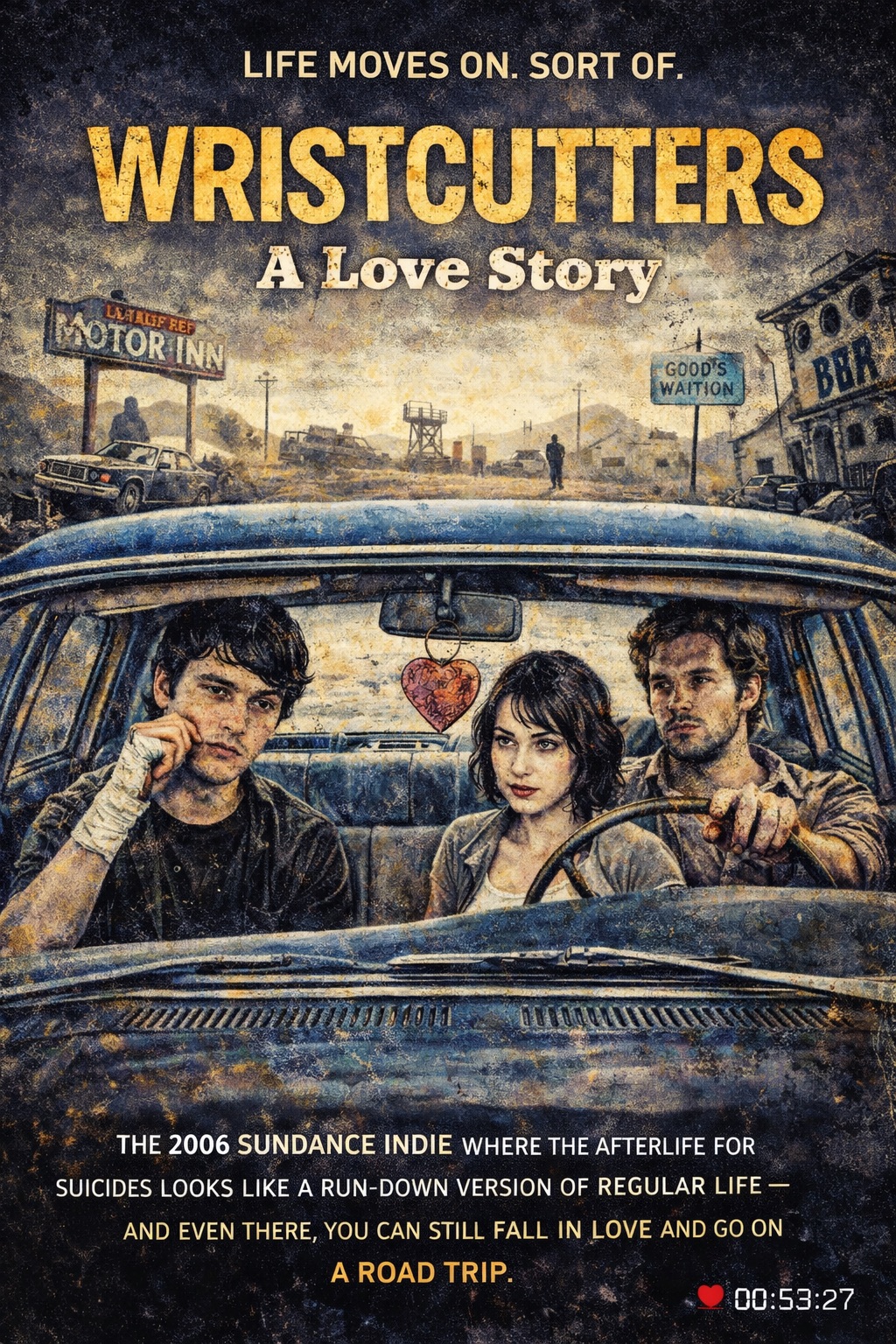

Welcome back to Cinema Obscura, where we dig up the weird, forgotten, and wonderfully strange corners of film history that most people never knew existed.
Key Takeaways
- Wristcutters: A Love Story is a 2006 American dark comedy directed by Croatian-born filmmaker Goran Dukic, based on the novella “Kneller’s Happy Campers” by Israeli author Etgar Keret.
- The film is set in a special afterlife reserved exclusively for people who have killed themselves — a world that looks exactly like regular life, only slightly worse, where nobody can smile and the sky is always overcast.
- The cast includes Patrick Fugit (Almost Famous), Shannyn Sossamon, Shea Whigham, and Tom Waits in a supporting role as a messianic commune leader named Kneller.
- Dukic got the film rights by asking Keret directly — and for free — after being introduced through a mutual friend, then made the entire film for approximately $1 million.
- It premiered at the 2006 Sundance Film Festival and was nominated for two Independent Spirit Awards, but took over a year to find theatrical distribution.

Duxtop 1800W Portable Induction Cooktop Countertop Burner, Gold 8100MC/BT-180G3
Requires induction compatible cookware. If a magnet sticks well to the bottom of the pan and is at...
As an affiliate, we earn on qualifying purchases.
The Worst Afterlife You Can Imagine
The genius of Wristcutters: A Love Story is its central conceit, which is both immediately funny and quietly devastating: the afterlife for people who have committed suicide is not fire and brimstone, not eternal torment, not nothingness. It’s just life again — but a little worse. Everything is slightly more run-down. The food is slightly less flavorful. The colors are slightly more faded. The sky never clears. And nobody — absolutely nobody — can smile.
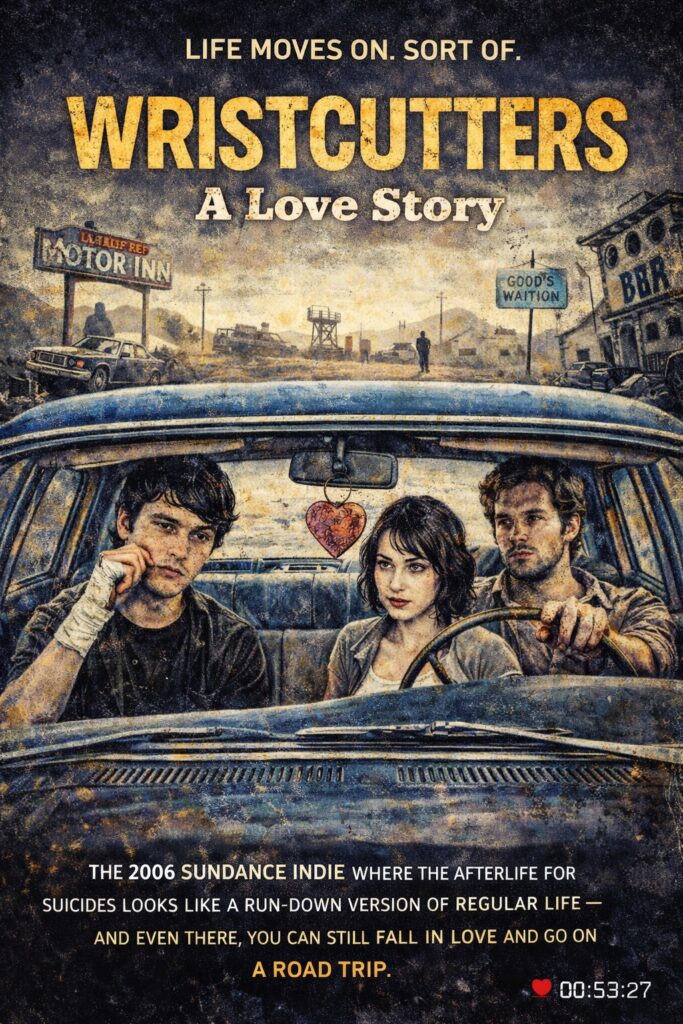
This last detail is the film’s most elegant touch. The actors were reportedly directed to suppress any upward movement of their mouths throughout filming, creating a world populated by people who are capable of humor, affection, and even joy but whose faces can never express it. The effect is both comic and heartbreaking — a visual metaphor for depression that works without ever calling attention to itself.
Zia (Patrick Fugit) arrives in this purgatory after slitting his wrists over a breakup with his girlfriend Desiree. He gets a dead-end job at a pizza place called Kamikaze Pizza. He shares a dingy apartment. He does the same things he did when he was alive, only now everything is marginally worse and he can’t even complain about it, because he chose this.
Then he learns that Desiree has also died — she killed herself shortly after he did — and is somewhere in this same afterlife. And so begins a road trip.

Duxtop Portable Induction Cooktop, Countertop Burner Induction Hot Plate with LCD Sensor Touch 1800 Watts, Silver 9600LS BT-200DZ
PORTABLE INDUCTION BURNER: Duxtop induction cooktop uses 110/120 V 15 amp electrical outlet–standard in all North American homes....
As an affiliate, we earn on qualifying purchases.
The Road Trip
Zia is joined by Eugene (Shea Whigham), a Russian musician who electrocuted himself with his bass guitar onstage and now lives with his equally dead parents and their perpetually malfunctioning car. Eugene is aggressive, funny, and infuriating — part of the film’s dark joke is that even in the afterlife, your road trip companion will get on your nerves.
The character of Eugene is partly based on two real people: Gur Bentwich, an Israeli writer and friend of source-material author Etgar Keret, and Eugene Hutz, the frontman of Gogol Bordello and a friend of director Goran Dukic. This blend of influences gives the character a specificity — part Eastern European melancholy, part punk rock belligerence — that feels entirely original.
Along the way, they pick up Mikal (Shannyn Sossamon), a woman who insists she doesn’t belong in this afterlife — that her death was an accidental overdose, not a suicide, and that she’s looking for the “People in Charge” to get her case reviewed. Mikal is the film’s emotional anchor: fierce, skeptical, and unwilling to accept the bleakness of her situation as permanent. Her growing connection with Zia unfolds with a tenderness that feels earned precisely because neither of them can smile while it’s happening.
The road trip takes them through a landscape of American desolation — abandoned gas stations, empty stretches of desert, crumbling diners — that was shot in downtown Los Angeles and surrounding areas. According to Dukic, most locations were used exactly as found, which says something about the state of certain parts of the American landscape in the mid-2000s.

OMEO Portable Induction Cooktop Hot Plate Countertop Burner 1800 Watts Induction Burner with LCD Sensor Touch, LED Display, 10 Temperature Levels, Child Safety Lock, Auto Shutoff Function
High-Power Cooking: The OMEO induction cooktop features 1800 Watts of power for fast, efficient cooking. Perfect for any...
As an affiliate, we earn on qualifying purchases.
Kneller’s Camp
The road eventually leads to a commune run by a character named Kneller, played by Tom Waits in a performance that feels less like acting and more like simply existing on camera. Waits’s Kneller is a philosophical drifter who has established a small community in the desert where the afterlife’s oppressive rules seem to bend. In his camp, small miracles occur — objects float in mid-air, matches light themselves, colors seem marginally brighter.
These miracles, the film suggests, occur only when people aren’t trying to make them happen — when they’ve stopped caring about outcomes and simply exist in the moment. It’s a philosophy that the film treats with genuine affection rather than irony, and Waits’s natural air of weathered wisdom makes Kneller’s commune feel like a place you’d actually want to visit, even if you had to die to get there.
The film’s mythology includes a bureaucratic apparatus called the “People in Charge” who manage the afterlife, keeping files on everyone’s death and — allegedly — occasionally sending people back. Whether this is literally true or just a rumor that gives the dead something to hope for is left deliberately ambiguous.

Nuwave Flex Precision Induction Cooktop, 10.25” Shatter-Proof Ceramic Glass, 6.5” Heating Coil, 45 Temps from 100°F to 500°F, 3 Wattage Settings 600, 900 & 1300 Watts, Black
MAKE ADJUSTMENTS ON-THE-FLY – Want hotter temperature or need to cook it longer? No problem. Simply adjust on-the-fly...
As an affiliate, we earn on qualifying purchases.
From Zagreb to Sundance
Goran Dukic was born in Zagreb, Croatia, and came to filmmaking through short films. His path to Wristcutters was characteristically indie: he was introduced to Etgar Keret’s work through a mutual friend and became fascinated by “Kneller’s Happy Campers,” a novella set in the same suicide afterlife. Keret had already received offers for the film rights from producers in Germany and France, but Dukic, operating without significant financial backing, asked if he could have the rights for free.
Keret agreed — on the condition that Dukic write a script to his satisfaction. Dukic did, and the result became a Sundance Institute project, developed through the Institute’s screenwriting lab. The finished film was made for approximately $1 million, an impressively low figure for a production that includes multiple locations, a large ensemble cast, and practical special effects.
The film premiered at the 2006 Sundance Film Festival, where it competed for the Grand Jury Prize. It was nominated for two Independent Spirit Awards: Best First Feature and Best First Screenplay. But despite positive reviews and festival buzz, theatrical distribution was slow to materialize. It took until October 2007 — nearly two years after its Sundance premiere — for the film to reach American theaters, where it was released in limited release before a modest wider expansion in November.
The Tone Problem (That Isn’t a Problem)
Wristcutters faced a challenge that many dark comedies face: how do you market a film whose premise involves suicide without either trivializing the subject or scaring off the audience? The film’s approach was to treat death as a logistical inconvenience rather than a tragedy — everyone in the afterlife is already dead, so the stakes become not survival but connection, purpose, and the possibility of second chances.
The New York Times named it a Critics’ Pick, noting that it had an offbeat, absurdist charm that turned a potentially uncomfortable concept into a touching adventure. Variety praised the film’s unmistakably Slavic sensibility and beautifully underplayed performances. The New York Post compared the result to what you’d get if you filtered The Wizard of Oz through the sensibilities of Emir Kusturica.
The soundtrack, featuring music by Gogol Bordello and an original score by Bobby Johnston, reinforces the film’s Eastern European emotional register — wry, melancholic, and capable of finding celebration in circumstances that would defeat more sentimental material. Tom Waits contributed songs as well, because of course he did.
A Cult That Keeps Growing
Wristcutters holds a 66% on Rotten Tomatoes and a 62 on Metacritic — scores that suggest a film more divisive than beloved. But aggregate scores don’t capture what the film has become in the years since its release: a genuine cult object, the kind of movie that people discover on their own and then become evangelical about. It’s a first-date movie for a very specific kind of person. It’s a comfort film for people who find comfort in bleakness. It’s the rare dark comedy that earns its subtitle — it really is a love story, one of the more unusual and affecting ones in recent independent cinema.
Dukic has not made another feature film with the same cultural impact, though he has remained active. His subsequent projects include the crime film Obsession and the upcoming science fiction project Cloud One, which reunites him with Etgar Keret as source-material author and stars Sophie Turner and Boyd Holbrook.
The fact that Wristcutters came from a Croatian director adapting an Israeli short story into an American indie film starring the kid from Almost Famous and the voice of Cookie Monster’s spiritual cousin is itself a kind of miracle — the kind that, in the film’s mythology, only happens when you’re not trying to make it happen.
Quick Facts
| Detail | Info |
|---|---|
| Title | Wristcutters: A Love Story |
| Year | 2006 (Sundance premiere); 2007 (theatrical) |
| Runtime | 88 minutes |
| Director | Goran Dukic |
| Screenplay | Goran Dukic, based on “Kneller’s Happy Campers” by Etgar Keret |
| Cinematography | Vanja Cernjul |
| Score | Bobby Johnston |
| Stars | Patrick Fugit, Shannyn Sossamon, Shea Whigham, Tom Waits, Leslie Bibb, John Hawkes, Will Arnett |
| Country | USA / UK |
| Distributor | Autonomous Films |
| Budget | ~$1 million |
| Rotten Tomatoes | 66% |
| Metacritic | 62/100 |
| Notable Nominations | Independent Spirit Award — Best First Feature, Best First Screenplay; Sundance Grand Jury Prize |
Frequently Asked Questions
What Is Wristcutters About?
After killing himself over a breakup, Zia finds himself in a special afterlife for suicides that resembles normal life but worse. When he learns his ex-girlfriend is also dead, he embarks on a road trip through the afterlife with a Russian rocker and a woman who claims she doesn’t belong there, searching for love, purpose, and possibly a way back.
Is Wristcutters Based on a Book?
It’s based on “Kneller’s Happy Campers,” a novella by Israeli author Etgar Keret, published in 1998. Keret is one of Israel’s most celebrated short story writers, known for his surrealist, darkly comic style. A graphic novel adaptation of the same story was published under the title Pizzeria Kamikaze.
Who Is Tom Waits in the Film?
Waits plays Kneller, the leader of a desert commune in the afterlife where small miracles seem to occur spontaneously. He brings his trademark gravelly warmth to a role that requires equal parts philosopher, cult leader, and benevolent drifter.
Is the Film Insensitive About Suicide?
The film treats suicide as a premise rather than a punch line. Its afterlife is specifically designed to be unsatisfying rather than punitive, and the emotional core of the story is about finding reasons to live — or to have lived — even after it’s too late. The tone is melancholic and affectionate rather than flippant.
Where Can I Watch Wristcutters?
The film is available for digital rental and purchase on most major platforms, and streams periodically on services including Amazon Prime Video and Tubi. Physical media releases include DVD editions.
Cinema Obscura is a recurring series on Choking on Popcorn where we explore the strangest, most forgotten, and most fascinating films that most people have never heard of. Got a suggestion for a future entry? Contact us.