
Welcome back to Cinema Obscura, where we dig up the weird, forgotten, and wonderfully strange corners of film history that most people never knew existed.
Key Takeaways
- Survive Style 5+ is a 2004 Japanese surrealist comedy directed by Gen Sekiguchi, a commercial and music video director making his first and (so far) only feature film.
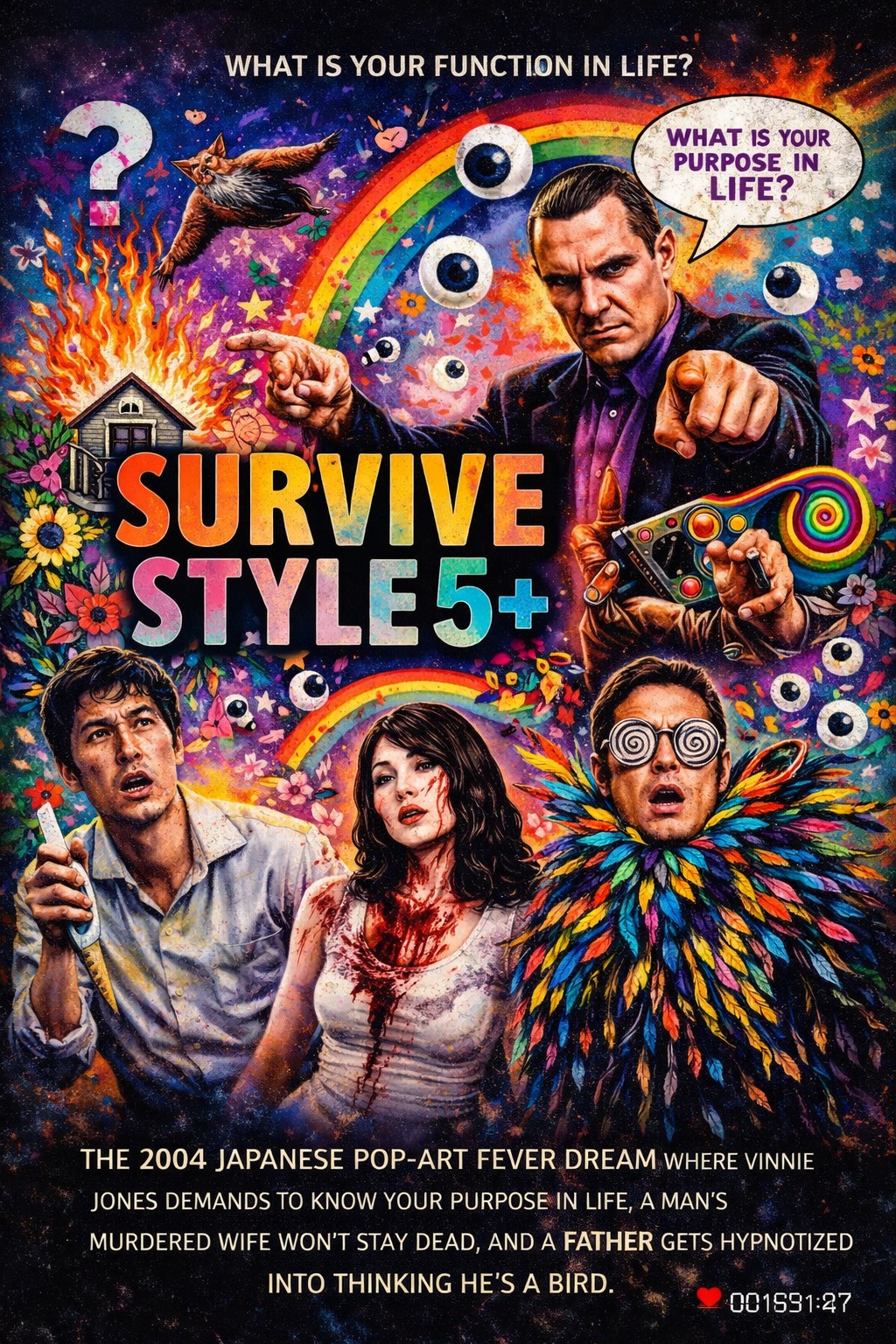
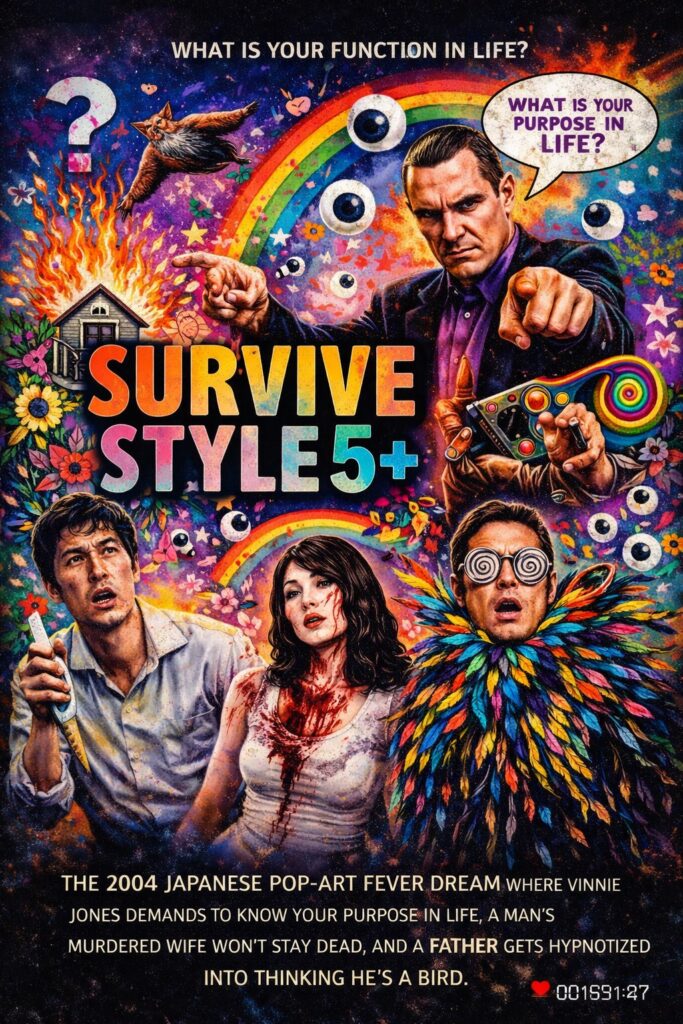
- The film weaves together five loosely connected storylines involving a man who can’t keep his wife dead, an existential British hitman (Vinnie Jones), a hypnotist whose mid-show murder leaves a father stuck thinking he’s a bird, a trio of teenage burglars, and an ad executive with terrible ideas.
- The production design is jaw-dropping — every frame looks like a pop-art installation, with color palettes and set designs that make Wes Anderson look restrained.
- Despite starring cult icons Tadanobu Asano (Ichi the Killer), Vinnie Jones (Lock, Stock and Two Smoking Barrels), and Sonny Chiba (Kill Bill), the film has never received a Region 1 DVD release in North America.
- Sekiguchi and screenwriter Taku Tada won the advertising award at the 2000 Cannes Film Festival — for a commercial, not a film — and brought their ad-world visual maximalism directly into the feature.
Top picks for "survive style"
Open Amazon search results for this keyword.
As an affiliate, we earn on qualifying purchases.
What Is Your Function in Life?
There is a scene early in Survive Style 5+ that tells you everything you need to know about the kind of film you’re watching. Vinnie Jones — the former professional footballer turned actor, the man whose face seems to have been specifically designed by evolution to intimidate — is sitting on an airplane. A flight attendant asks him to raise his seat back. His translator, a small man in a sharp yellow plaid jacket, relays the request. Jones complies.
Then he calls the attendant back. Through his translator, he asks her a question: “What is your function in life?”
She is, understandably, confused. She gives him her job title. Jones is not satisfied. “That’s not what I mean,” he growls. “What is your purpose for living?”
The attendant has no answer. Jones grows more insistent. The translator barks follow-up questions with increasing urgency. The woman begins to panic. And you realize, with a mixture of delight and alarm, that this is not a joke. Vinnie Jones’s character is genuinely, philosophically invested in understanding every person’s reason for existing. He will ask this question of virtually everyone he meets for the remainder of the film. Some people will answer well. Some will answer poorly. The consequences will vary accordingly.
This is the energy of Survive Style 5+ — a film that is simultaneously absurd and completely sincere, violent and tender, visually overwhelming and emotionally precise.
Five Stories, One Universe
The film operates as what’s sometimes called hyperlink cinema — multiple storylines running simultaneously, intersecting at unpredictable angles.
The Man and His Wife: A man (Tadanobu Asano) has murdered his wife (Reika Hashimoto). He buries her in the woods. She comes back. He kills her again. She comes back again, each time in a different elaborate outfit, each time returning to their extraordinary home to resume domestic life as though nothing happened. He keeps killing her. She keeps returning. Neither of them speaks much. Their relationship exists in a space beyond language, beyond reason, beyond death itself.
The Hitman: Vinnie Jones plays a British contract killer who has arrived in Japan with his translator (Yoshiyoshi Arakawa) for a job. His defining characteristic, beyond his capacity for violence, is his obsessive need to understand everyone’s purpose. The translator — impeccably dressed, unfailingly polite, and clearly terrified of his employer — must convey Jones’s profane existential inquiries in Japanese, creating a running gag that is funny in two languages simultaneously.
The Birdman: A salaryman named Kobayashi (Ittoku Kishibe) wins tickets to a stage hypnotism show featuring the flamboyant Aoyama (Hiroshi Abe). Kobayashi is brought onstage and hypnotized into believing he is a bird. Before Aoyama can bring him out of the trance, events intervene. Kobayashi spends the rest of the film perched on furniture, pecking at food, and flapping his arms, while his bewildered children try to manage a father who genuinely believes he can fly.
The Burglars: Three teenage friends — a mix of Japanese and Western — break into houses for thrills. Their burglary of one particular home sets off a chain of consequences that links their story to the others.
The Ad Executive: Yoko (Kyoko Koizumi) is a creative director at an advertising agency whose pitches are so absurdly terrible that they loop back around to being brilliant — or possibly remain terrible. Her relationship with the hypnotist Aoyama brings her storyline crashing into the hitman’s.
A Commercial Director’s Feature
Gen Sekiguchi came to Survive Style 5+ from the world of advertising and music videos, and it shows — not as a criticism, but as a statement of fact about where the film’s visual DNA originates. Every frame of the film is composed with the precision and chromatic intensity of a luxury brand campaign. The color palette shifts dramatically between storylines: Asano’s home is a cubist art museum with mustard walls, painted flowers, geometric floors, and freestanding staircases. The hypnotist’s stage show is all neon and fog. The burglars move through spaces that feel like magazine spreads.
Sekiguchi and screenwriter Taku Tada had already established themselves as a creative team in the advertising world, winning the advertising prize at the 2000 Cannes Film Festival. Their commercial sensibility — maximum visual impact in minimum time, every shot composed for immediate legibility and emotional punch — translates surprisingly well to a feature-length narrative. The film never drags, despite a 120-minute runtime, because every scene is designed to deliver something visually arresting within its first few seconds.
The set design deserves special mention. Asano’s house is the standout — a modernist fantasy with bas-relief sculptures, artwork on every wall, and a color scheme that changes with his wife’s mood or wardrobe. We learn nothing about his character’s profession or backstory, but in the film’s cracked universe, it seems perfectly natural that he would live in a space that looks like a contemporary art gallery. The production designer, working with costume designer Ikuko Utsunomiya, created a visual world that exists somewhere between a Tokyo department store and a Roy Lichtenstein painting.
The Cast
The casting is a minor miracle of cross-cultural weirdness. Tadanobu Asano, one of Japan’s most versatile actors (known internationally for Ichi the Killer, Zatoichi, and later Thor and Silence), plays the wife-killing husband with a stoic intensity that makes his absurd situation feel genuinely poignant. He barely speaks, communicating instead through action, expression, and the increasingly elaborate ways he attempts to dispose of his wife.
Vinnie Jones, operating entirely in English while surrounded by Japanese speakers, turns what could have been a one-note tough-guy performance into something surprisingly philosophical. The dynamic between Jones and his translator is the film’s comedic backbone — Jones’s profane, aggressive English being rendered into polite, measured Japanese, and vice versa, creates a running translation comedy that works regardless of which language you understand.
Hiroshi Abe (who would later become one of Japan’s biggest television stars) is magnificently self-absorbed as the hypnotist. Sonny Chiba, the legendary martial arts star, appears in a supporting role. And in small parts, you can spot Rinko Kikuchi (who would earn an Oscar nomination for Babel two years later) and Ryunosuke Kamiki, then a child actor, as Kobayashi’s son.
The Ending
Without revealing specifics, the film’s conclusion is one of its greatest achievements — a moment where all five storylines converge in a way that is both narratively satisfying and emotionally devastating. What has been, for most of its runtime, a cheerfully anarchic exercise in style suddenly reveals that it has been building toward something genuinely moving.
The question “What is your function in life?” — repeated so often that it becomes a catchphrase, then a joke, then a threat — ultimately receives an answer that reframes everything that came before it. The film argues, through all its pop-art maximalism and surrealist violence, that the answer to existential questions is not philosophical but relational. Your function is defined by the people you love and the ways you fail them.
It’s an unexpectedly sincere conclusion for a film in which a man repeatedly murders his wife and a father spends forty minutes acting like a chicken.
Why You’ve Never Seen It
Survive Style 5+ premiered at the Locarno Film Festival in August 2004, where Variety‘s review was memorably unkind. The film was released theatrically in Japan in September 2004 and received home video releases in Japan (Geneon), the UK (Magna), and Australia (Eastern Eye). But it has never received a Region 1 release in North America, which means most English-speaking audiences have either never heard of it or have encountered it only through imported discs and less official channels.
This is a genuine shame. The film has built a passionate cult following among viewers who have managed to track it down, and its combination of visual invention, tonal audacity, and surprisingly affecting emotional core makes it one of the most rewarding discoveries in 2000s Japanese cinema. It’s the kind of film you finish watching and immediately want to show to someone else — partly because it’s wonderful, and partly because you need another human being to confirm that what you just saw actually happened.
Quick Facts
| Detail | Info |
|---|---|
| Title | Survive Style 5+ |
| Year | 2004 |
| Runtime | 120 minutes |
| Director | Gen Sekiguchi |
| Screenplay | Taku Tada |
| Cinematography | Makoto Shiguma |
| Score | James Shimoji |
| Stars | Tadanobu Asano, Reika Hashimoto, Vinnie Jones, Yoshiyoshi Arakawa, Ittoku Kishibe, Hiroshi Abe, Kyoko Koizumi, Sonny Chiba |
| Country | Japan |
| Production | Tohokushinsha Film Corp. / Dentsu |
| Distributor | Various international (no Region 1 release) |
| IMDb Rating | 7.4/10 |
| Letterboxd Rating | 3.8/5 |
Frequently Asked Questions
What Is Survive Style 5+ About?
The film follows five interconnected storylines: a man whose murdered wife keeps coming back from the dead, a British hitman obsessed with knowing everyone’s purpose in life, a father hypnotized into thinking he’s a bird, a trio of teenage burglars, and an ad executive with spectacularly bad ideas. Their stories collide over the course of the film in increasingly unexpected ways.
Is This Vinnie Jones’s Weirdest Role?
Quite possibly. Jones plays an English-speaking hitman in Japan who is genuinely concerned with existential philosophy. His every interaction is mediated through a Japanese translator, creating a bilingual comedy dynamic that is unlike anything in Jones’s filmography — or anyone else’s.
Has Gen Sekiguchi Made Other Films?
Survive Style 5+ remains his only feature film. He has directed two short films and contributed to the 2011 anthology Quirky Guys and Girls, but his primary career continues to be in advertising and music videos. Whether this makes Survive Style 5+ a one-off masterpiece or a missed career is a matter of perspective.
Why Is It So Hard to Find?
The film never received a North American Region 1 DVD or Blu-ray release. It is available through imported discs from Japan, the UK, and Australia, but these require all-region players. Its availability on streaming platforms is limited and varies by territory.
Who Should Watch This Film?
If you enjoy visually inventive cinema, dark comedy, ensemble narratives in the vein of Pulp Fiction or Magnolia, or Japanese pop culture at its most creatively unhinged, Survive Style 5+ is essential. It’s also a strong recommendation for anyone who has ever enjoyed Vinnie Jones on screen and wondered what he might be like as an existential philosopher.
Cinema Obscura is a recurring series on Choking on Popcorn where we explore the strangest, most forgotten, and most fascinating films that most people have never heard of. Got a suggestion for a future entry? Contact us.