Welcome back to Cinema Obscura, where we dig up the weird, forgotten, and wonderfully strange corners of film history that most people never knew existed.
Key Takeaways
- Hausu (House) is a 1977 Japanese horror-comedy directed by Nobuhiko Obayashi, about seven schoolgirls devoured one by one in a haunted countryside home.
- Toho Studios commissioned the film as their answer to Jaws — the result was so incomprehensible that no staff director would touch the script for two years.
- Many of the film’s most surreal ideas came from Obayashi’s pre-teen daughter Chigumi, who contributed concepts like a piano that eats people and a mirror reflection that attacks.
- The film was critically dismissed in Japan upon release but won Obayashi the Blue Ribbon Award for Best New Director in 1978.
- After decades of obscurity, the Criterion Collection released the film in 2010, sparking a massive cult following in the West.
Top picks for "hausu house"
Open Amazon search results for this keyword.
As an affiliate, we earn on qualifying purchases.
How Do You Describe Hausu?
The Criterion Collection’s own marketing copy opens with the question: “How to describe Nobuhiko Obayashi’s indescribable 1977 movie House?” They then suggest a psychedelic ghost tale, a stream-of-consciousness bedtime story, or an episode of Scooby-Doo as directed by Mario Bava. The BFI went with “The Evil Dead meets Yellow Submarine.” Others have tried Rocky Horror by way of a Max Fleischer fever dream.
None of these descriptions are wrong. None of them are adequate, either.
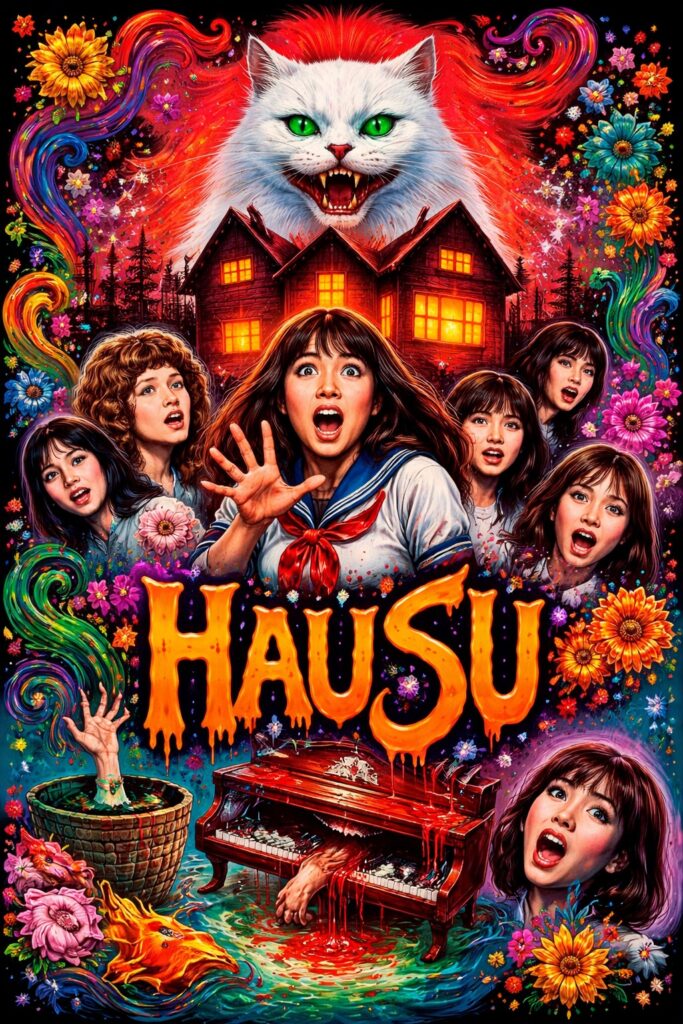
Here’s the plot, such as it is. A schoolgirl nicknamed Gorgeous learns that her widowed father is remarrying. Upset, she decides to spend summer vacation at her aunt’s countryside home instead. She brings along six friends, each named for their single defining trait: Kung Fu (the athletic one), Prof (the smart one), Fantasy (the daydreamer), Mac (the one who eats), Melody (the musician), and Sweet (the kind one).
They arrive at the aunt’s creaking estate. The aunt is in a wheelchair. There’s a cat named Blanche whose eyes glow. And then, one by one, the house begins eating the girls. A piano bites off Melody’s fingers and then consumes her entirely. Mattresses attack. A severed head flies out of a well and bites Fantasy on the backside. Kung Fu battles floating logs and a possessed light fixture. Mac is devoured by a refrigerator.
None of this is played for conventional scares. The special effects — matte paintings, hand-drawn animation, stop-motion, early chroma key compositing — are deliberately, aggressively artificial. The editing is manic, anticipating MTV aesthetics four years before MTV existed. The tone swerves between genuine eeriness, slapstick comedy, and something that can only be described as hallucinatory joy.
It is, by any reasonable standard, one of the strangest films ever produced by a major studio.
The Jaws of Japan (Sort Of)
The origin story is almost as bizarre as the film itself. Following the enormous global success of Steven Spielberg’s Jaws in 1975, the legendary Toho Studios — home of Godzilla — approached Nobuhiko Obayashi with a proposition: make them something like Jaws. Obayashi was, at this point, primarily known as a prolific director of television commercials. He’d made ads with Kirk Douglas and Charles Bronson. He had no feature film experience whatsoever.
Rather than study what made Jaws work commercially, Obayashi turned to his pre-teen daughter Chigumi for inspiration. His reasoning was characteristically unorthodox: he believed adults only thought about things they understood, that “everything stays on that boring human level,” while children could generate ideas that defied rational explanation.
Chigumi delivered. A watermelon pulled from a well that looks like a severed head. A reflection in a mirror that attacks the person looking into it. A pile of futons that falls on someone like a living monster. A house that eats girls. These weren’t metaphors she was working from — they were distillations of her own childhood fears, things like getting her fingers stuck between piano keys or being terrified by a loud clock at her grandparents’ house.
Obayashi brought these ideas to screenwriter Chiho Katsura, who found they reminded her of a Walter de la Mare story about an old woman who lures her granddaughters into a trunk. Together they built a script. Toho read it, couldn’t make sense of it, and shelved it. No staff director would agree to helm the project. It sat in limbo for two years.
During those two years, Obayashi promoted the concept relentlessly — publishing a novelization, producing a radio drama adaptation, and creating promotional campaigns that generated genuine public curiosity. Eventually, Toho’s patience (or perhaps their desperation) won out. As Obayashi later recalled, his producer told him the studio “was tired of losing money on comprehensible films” and was ready to let him direct “the incomprehensible” one.
The Atomic Shadow
Beneath the candy-colored chaos, Hausu carries a genuine emotional weight that many first-time viewers miss entirely. Obayashi was born in Hiroshima in 1938. He was seven years old when the atomic bomb fell. He lost every childhood friend he had.
This history threads through the film in ways that become apparent only on reflection. The aunt — beautiful, ethereal, waiting endlessly for a lover who went to war and never returned — is a ghost of wartime Japan. Her bitterness over the war has transformed her into something monstrous, consuming the younger generation who were spared the bombing’s horrors. The girls, with their bubble-gum innocence and goofy nicknames, represent a postwar Japan that has moved on, unaware of the grief still embedded in the walls of the country’s older houses.
The film’s transition from bright, poppy comedy to genuine horror mirrors the experience of innocence colliding with historical trauma. It’s doing something far more sophisticated than its reputation for “randomness” suggests — though it’s also, genuinely, a movie where a cat painting shoots blood from its mouth, so draw your own conclusions about intentionality.
The Cast and the Chaos
Obayashi cast many of the seven girls from models who had appeared in his commercials. The most experienced actors in the ensemble were Kimiko Ikegami (Gorgeous) and Yoko Minamida (the aunt). Minamida was reluctant to take the role, worrying it would damage her reputation as a serious stage and television actress. Country singer Kiyohiko Ozaki, who plays the girls’ hapless teacher Mr. Togo, landed the part because he and Obayashi shared a horseback riding hobby.
Family members filled out the background: Obayashi’s daughter Chigumi — whose ideas fueled the entire project — plays a little girl at a shoemaker’s shop. The film’s production designer plays the shoemaker. The soundtrack was performed by Godiego, a Japanese rock band who would go on to greater fame with the theme song for the television series Monkey.
The film was shot on one of Toho’s largest soundstages without a storyboard, over roughly two months. Given the sheer density of visual effects, animation overlays, and editing tricks crammed into its 88 minutes, that production timeline borders on the miraculous.
Thirty Years in the Wilderness
Hausu was a box office success in Japan, but critics largely dismissed it. For the next three decades, it existed in a kind of twilight — known to a handful of devoted Japanese fans and virtually invisible in the West.
The Criterion Collection changed everything. Their 2010 DVD and Blu-ray release — complete with a making-of documentary, Obayashi’s 1966 experimental short Emotion, and an appreciation by Ti West — introduced the film to an entirely new audience. The response was immediate and enthusiastic. Repertory theaters began booking it for midnight screenings across North America. The Rotten Tomatoes consensus eventually settled on the kind of baffled praise that defines cult cinema: “A silly, surreal cross of Japanese horror, anime and just plain weirdness, this 1977 fever dream of styles makes you wonder: How did this ever get made?”
The film now regularly appears on lists of the greatest cult films ever made. Repertory screenings continue to sell out. The Philadelphia Film Society ran a full Obayashi director series in 2025, anchored by Hausu.
Obayashi himself continued making films for decades — many of them exploring similar themes of memory, loss, and wartime trauma through wildly imaginative visual storytelling. His final film, Labyrinth of Cinema (2020), was completed while he was terminally ill with cancer. He passed away on April 10, 2020, at the age of 82.
Should You Watch It?
If you have any appetite whatsoever for films that operate outside the boundaries of conventional storytelling, Hausu is essential viewing. It’s 88 minutes long, it’s available through Criterion, and there is literally nothing else in cinema that feels like it. Not Evil Dead, not Suspiria, not Rocky Horror — those are all comparisons of convenience, not accuracy.
The experience of watching Hausu for the first time is singular. You will laugh. You will be confused. You will wonder if the filmmakers were operating under the influence of substances or simply of unchecked imagination. You will see a piano eat a girl and realize you have no framework for processing that image. And then you will almost certainly want to watch it again, because the sheer density of invention means there’s always something you missed.
This is the film that Toho greenlit because they were sick of comprehensible cinema. Forty-eight years later, it remains gloriously, triumphantly incomprehensible — and all the better for it.
Quick Facts
| Detail | Info |
|---|---|
| Title | Hausu (ハウス) / House |
| Year | 1977 |
| Runtime | 88 minutes |
| Director | Nobuhiko Obayashi |
| Screenplay | Chiho Katsura (story by Nobuhiko Obayashi and Chigumi Obayashi) |
| Country | Japan |
| Studio | Toho |
| Music | Asei Kobayashi, Mickie Yoshino (Godiego) |
| Home Video | Criterion Collection (DVD/Blu-ray, 2010) |
| IMDb Rating | 7.2/10 |
| Rotten Tomatoes | 89% (critics) |
| Awards | Blue Ribbon Award — Best New Director (1978) |
Frequently Asked Questions
Is Hausu a Horror Film or a Comedy?
Both, and neither, and something else entirely. The film deploys genuine horror imagery — girls are devoured, dismembered, and consumed — but frames them within a pop-art visual style that makes the violence feel more surreal than frightening. It’s closest to what might be called “horror-comedy” but operates at an intensity level that transcends the genre.
Why Is the Film Called “House” in English?
Director Obayashi deliberately chose an English-language title for a Japanese film, which he considered “taboo” at the time. He felt the foreignness of the title matched the foreignness of the film’s approach.
Where Did the Ideas Come From?
Many of the film’s most iconic sequences originated with Obayashi’s pre-teen daughter Chigumi, who drew from her own childhood fears. The piano that eats people, for instance, came from her anxiety about getting her fingers caught between piano keys.
Why Did It Take So Long to Become a Cult Film?
The film was a commercial success in Japan in 1977 but was critically dismissed and never received proper Western distribution. It circulated only through rare bootleg copies until the Criterion Collection released it in 2010, sparking immediate cult worship.
Did Obayashi Make Other Films?
Yes — Obayashi had a prolific career spanning decades, directing over 40 features. His later work, particularly Labyrinth of Cinema (2020), continued exploring themes of memory, war, and loss through equally inventive visual storytelling. He passed away in April 2020.
Cinema Obscura is a recurring series on Choking on Popcorn where we explore the strangest, most forgotten, and most fascinating films that most people have never heard of. Got a suggestion for a future entry? Contact us.