
Open a free Amazon Business account
Business pricing, bulk buying and tax-exempt orders.
Create a free accountAs an affiliate, we earn on qualifying purchases.
Welcome back to Cinema Obscura, where we dig up the weird, forgotten, and wonderfully strange corners of film history that most people never knew existed.
Key Takeaways
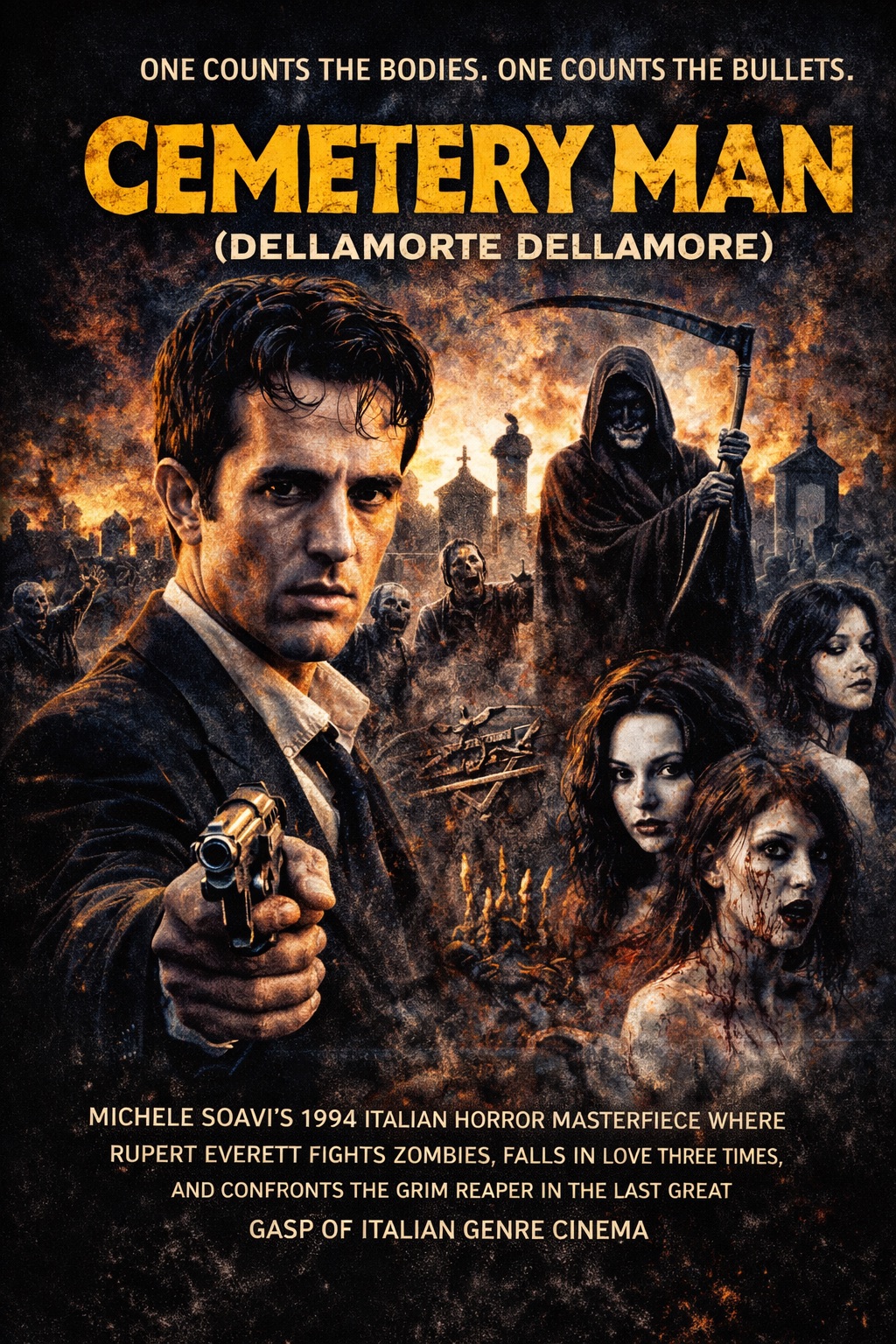
- Cemetery Man (originally titled Dellamorte Dellamore, meaning “Of Death, Of Love”) is a 1994 Italian horror film directed by Michele Soavi, widely considered the last great film of the Italian horror tradition.
- Rupert Everett stars as Francesco Dellamorte, a cemetery caretaker who casually dispatches the dead when they climb out of their graves — a role he was born to play, since the source material’s comic book character was literally modeled on his face.
- The film is based on a novel by Tiziano Sclavi, who also created the massively popular Italian comic Dylan Dog — a character whose appearance was based on Everett without the actor’s knowledge.
- Director Martin Scorsese called it one of the best Italian films of the 1990s, yet it grossed only $253,969 at the box office and vanished from theaters almost immediately.
- After this film, Soavi essentially abandoned genre cinema entirely, spending the next three decades making crime dramas and historical television in Italy.
Top picks for "cemetery dellamorte dellamore"
As an affiliate, we earn on qualifying purchases.
The Last Zombie Standing
Italian horror cinema had a problem in the early 1990s. The problem was that Italian horror cinema was, for all practical purposes, dead.
The glorious, gory, wildly inventive tradition that had produced Dario Argento, Lucio Fulci, Mario Bava, and dozens of lesser-known lunatics had run out of momentum. The master directors were repeating themselves or struggling to find financing. The Italian film industry was contracting. And the audience that had once packed grindhouse theaters to watch Italian zombies shamble across the screen had moved on to other things.
Into this wasteland walked Michele Soavi — Argento’s protégé, a man who had acted in Fulci’s City of the Living Dead, directed documentaries about Argento, and served as assistant director to Terry Gilliam on The Adventures of Baron Munchausen. He had already made three solid genre films: StageFright (1987), The Church (1989), and The Sect (1991). But Dellamorte Dellamore was something different. It was, as it turned out, the last great Italian horror film — a work so singular that the tradition essentially died alongside it.
The Setup
Francesco Dellamorte is the caretaker of Buffalora Cemetery, a small-town Italian graveyard where the dead have an inconvenient habit of climbing back out of the ground about seven days after burial. Dellamorte calls them “Returners.” He doesn’t know why they return, and he doesn’t particularly care. He just shoots them in the head and reburies them. It’s easier than filing the paperwork.
His only companion is Gnaghi, a mute, possibly intellectually disabled assistant played by the French actor François Hadji-Lazaro with an affecting tenderness that grounds even the film’s wildest moments. Dellamorte reads outdated phone directories for fun, crossing out the names of the dead. Rumors circulate in town that he’s impotent. He does not correct them.
Then a woman appears at a funeral — the young widow of a wealthy older man — and Dellamorte falls catastrophically in love. Their relationship consummates itself on her late husband’s grave, which goes about as well as you’d expect in a film where the dead don’t stay buried. What follows is a spiraling descent through romantic obsession, existential crisis, and escalating madness, as the same woman appears to return in different forms (all played by the Italian supermodel Anna Falchi), and Death himself shows up to offer some career advice.
“Stop killing the dead,” Death suggests. “Start killing the living instead.”
The Dylan Dog Connection
The story behind the casting is one of cinema’s better ironies. In 1986, Italian comic book writer Tiziano Sclavi created Dylan Dog, a paranormal investigator who became one of the most popular comic book characters in European history. When Sclavi described the character to his illustrator, he told him to base Dylan Dog’s appearance on the British actor Rupert Everett. This was done without Everett’s knowledge or consent.
Three years before the comic, Sclavi had written the novel Dellamorte Dellamore (published in 1991 but written in 1983), featuring the character of Francesco Dellamorte — who shares certain traits and philosophical tendencies with Dylan Dog. The character had even appeared in an issue of the Dylan Dog comic series. When it came time to adapt the novel into a film, the filmmakers faced a problem: they needed to cast a lead who looked like Dylan Dog, who looked like Rupert Everett, because he was based on Rupert Everett.
So they cast Rupert Everett. And they dressed him in a style deliberately reminiscent of Dylan Dog’s trademark look. The result is perhaps the only case in film history where an actor was cast because a fictional character had already been modeled on his face.
Everett delivers what may be the most world-weary performance in the history of zombie cinema. He plays Dellamorte with a languid narcissism that somehow becomes deeply sympathetic — a man so exhausted by the absurdity of his existence that even the dead rising from their graves barely registers as an inconvenience. It’s a performance that one reviewer likened to what you’d get if Evil Dead’s Ash Williams were the protagonist of a François Truffaut film.
Soavi’s Visual Imagination
Michele Soavi’s direction is the film’s greatest asset. Where his mentor Argento favored swirling camera movements and Fulci leaned into extreme gore, Soavi developed something more subtle — a visual style that balanced Gothic atmosphere with dark romance and surreal comedy. The cemetery itself is a masterpiece of production design: perpetually fog-shrouded, lit by moonlight, with smoke curling from the graves like the earth itself is breathing.
The special effects, handled by the legendary Sergio Stivaletti (who had worked on virtually every major Italian horror film of the 1980s), are practical, tactile, and often beautiful in their grotesquerie. A severed head continues a tender romance with Gnaghi. The dead emerge from their graves with a quiet dignity that makes the violence that follows genuinely jarring. The score, by Manuel De Sica (son of the great neorealist director Vittorio De Sica), shifts between romantic lyricism and ominous dread with an elegance that the film’s genre trappings don’t immediately suggest.
The real achievement is tonal. Cemetery Man manages to be simultaneously a zombie comedy, a Gothic romance, an existential meditation, and a genuine horror film — often within the same scene. The opening shot establishes this perfectly: Dellamorte answers the phone, there’s a knock at the door, he opens it, shoots the zombie standing there in the head with barely a glance, and returns to his conversation. It’s funny, casual, violent, and deeply sad all at once.
A Hit at Home, Invisible Abroad
Dellamorte Dellamore was a hit in Italy. It was produced as an international co-production between Italy, France, and Germany, with a budget of approximately $4 million. But its North American release, retitled Cemetery Man and distributed by October Films, was a disaster. It grossed under $254,000 at the US box office — a figure that suggests it may not have played in more than a handful of theaters.
The problem, as producers and critics have suggested in retrospect, was marketing. Nobody knew how to sell the film. It wasn’t a straightforward zombie movie. It wasn’t a straightforward romance. It wasn’t a comedy, exactly, though it was frequently hilarious. The hybrid nature that made it artistically interesting made it commercially impossible to categorize. The audience for Italian horror had largely evaporated, the arthouse audience didn’t know Soavi existed, and the mainstream horror audience in 1994 was busy watching Interview with the Vampire.
Over the following decades, the film built a cult reputation that its theatrical run never hinted at. Bloody Disgusting rated it five out of five stars and called it one of the greatest cult films of the last twenty years. The Museum of Modern Art programmed it. And Martin Scorsese, whose taste in Italian cinema is essentially unimpeachable, named it one of the best Italian films of the 1990s.
The End of an Era
What makes Cemetery Man particularly poignant is what came after — or rather, what didn’t. After completing the film, Michele Soavi essentially left genre cinema behind. He has continued working steadily in Italy, but almost exclusively in crime dramas, historical miniseries, and television. No follow-up to Cemetery Man has materialized, despite periodic reports of a sequel. The last great Italian horror director simply stopped making horror films.
The timing feels almost symbolic. Cemetery Man is a film about a man whose job is to put the dead back in the ground, who keeps doing it even though he knows it’s futile, who keeps falling in love even though love keeps dying on him. It’s hard not to read it as an allegory for the state of Italian genre cinema itself — still going through the motions, still capable of moments of genuine beauty, but aware on some level that the game is over.
The Latin inscription above the cemetery gate reads Resurrecturis — “For those who will rise again.” As a description of the film’s own fate, traveling from box office oblivion to cult immortality, you couldn’t script it better.
Quick Facts
| Detail | Info |
|---|---|
| Title | Dellamorte Dellamore (Cemetery Man) |
| Year | 1994 |
| Runtime | 105 minutes |
| Director | Michele Soavi |
| Screenplay | Gianni Romoli, based on the novel by Tiziano Sclavi |
| Cinematography | Mauro Marchetti |
| Score | Manuel De Sica |
| Stars | Rupert Everett, François Hadji-Lazaro, Anna Falchi |
| Country | Italy / France / Germany |
| Distributor | October Films (US) |
| Budget | ~$4 million |
| Box Office | $253,969 (US) |
| Special Effects | Sergio Stivaletti |
Frequently Asked Questions
What Is Cemetery Man About?
The film follows Francesco Dellamorte, a cemetery caretaker in the Italian town of Buffalora, who must regularly destroy the dead when they rise from their graves as zombies. After falling in love with a beautiful widow, he spirals into an existential crisis involving romantic obsession, encounters with Death personified, and increasingly unhinged behavior as the boundary between the living and the dead collapses around him.
What Is the Connection to Dylan Dog?
Tiziano Sclavi, who wrote the source novel, also created the hugely popular Italian comic book character Dylan Dog in 1986. Dylan Dog’s appearance was explicitly based on Rupert Everett, and the character shares thematic DNA with Francesco Dellamorte. The casting of Everett in the film was a deliberate nod to this connection. A separate, poorly received Dylan Dog film starring Brandon Routh was made in 2011.
Why Is the Film Called Dellamorte Dellamore?
The Italian title is a wordplay on the protagonist’s surname. “Della morte” means “of death” and “dell’amore” means “of love” — so the title translates roughly to “Of Death, Of Love,” which captures the film’s dual obsessions perfectly. The blunter English title Cemetery Man was chosen for international marketing.
Who Is Michele Soavi?
Soavi is an Italian director who apprenticed under Dario Argento and appeared as an actor in several Italian horror films, including Lucio Fulci’s City of the Living Dead. He also worked as an assistant director for Terry Gilliam. Cemetery Man is widely considered his masterpiece. After its release, he shifted almost entirely to television and non-genre filmmaking.
Where Can I Watch Cemetery Man?
The film has had various home video releases over the years, including DVD editions from Anchor Bay Entertainment. Arrow Video included a restored version in their Blu-ray catalog. Availability on streaming platforms varies by region — it’s worth checking specialty horror streaming services.
Is There Really Going to Be a Sequel?
Reports of a sequel have surfaced periodically since at least 2011, when Fangoria reported that Soavi was planning one. As of this writing, no sequel has materialized, though the idea has never been officially abandoned.
Cinema Obscura is a recurring series on Choking on Popcorn where we explore the strangest, most forgotten, and most fascinating films that most people have never heard of. Got a suggestion for a future entry? Contact us.
Flea & tick season Picks
flea and tick prevention
As an affiliate, we earn on qualifying purchases.